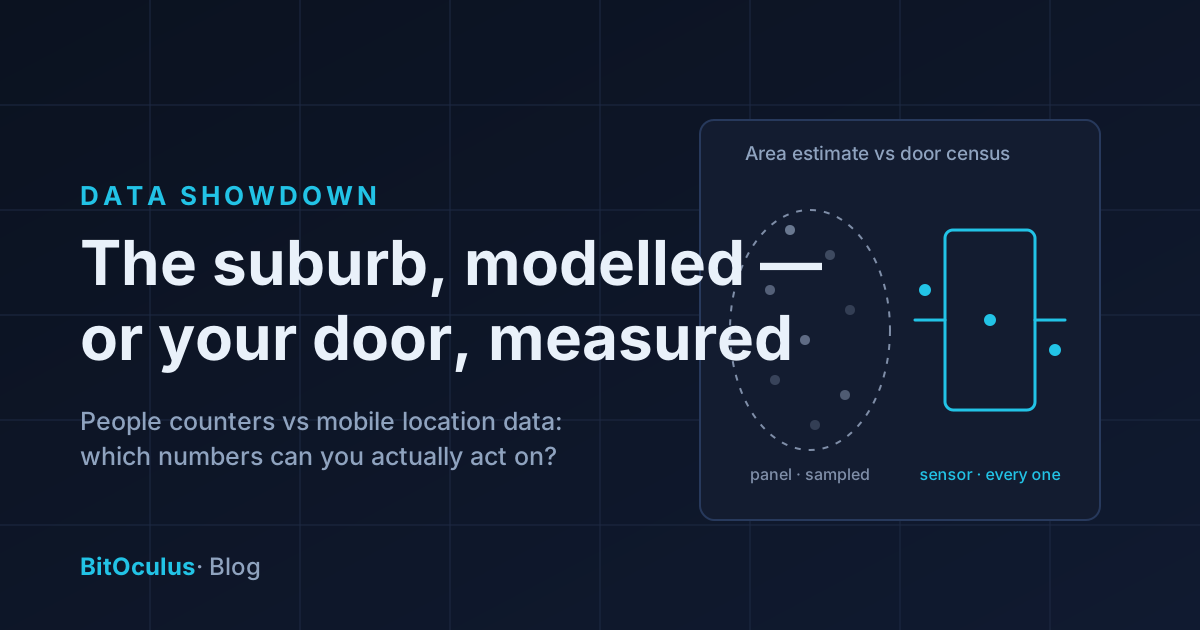
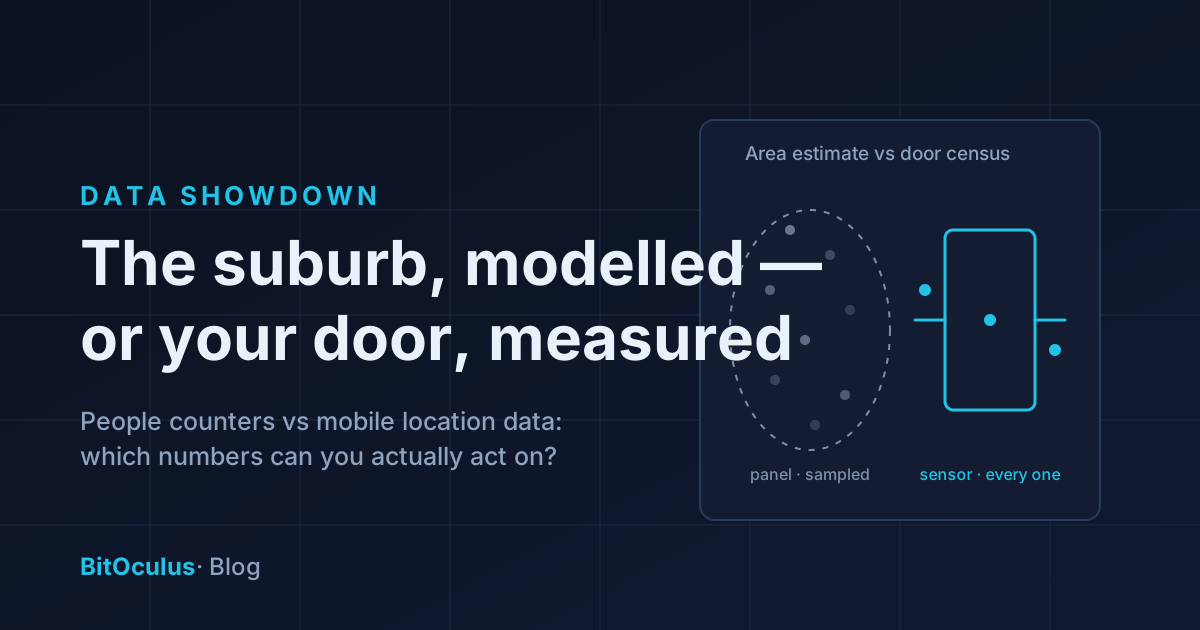
"Foot traffic data" is sold in two fundamentally different forms: aggregated mobile-location panels, which model area-level movement from a sample of smartphones, and on-site sensors, which count every person at a specific door. Panels answer market questions — how busy is that precinct, how does it trend, where do visitors come from. Sensors answer operating questions — how many people passed and entered your shopfront this hour, and what your window and floor did with them. Buy the wrong one for your question and the data is somewhere between useless and misleading. Plenty of operators have paid for one expecting the other, and the disappointment runs in both directions.
Here's how the two actually work, what each can and can't tell you, and a simple rule for choosing.
How each one gets its numbers
Mobile location data platforms buy anonymised, opt-in location pings from panels of smartphone apps, then model movement patterns from that sample: estimated visits to areas and large venues, trade areas, cross-visitation, trends over time. The panel is a small slice of the population, so everything is extrapolated — the output is an estimate of an area, strongest where crowds are large and geography is forgiving.
On-site sensors measure the physical space directly. An edge-AI unit above your door detects and counts actual people — entries, exits, passers-by, direction — processing frames on-device and discarding them instantly. Nothing is sampled or modelled; the number is a census of your threshold, specific to your frontage and updated in real time.
The honest framing isn't "which is better" — it's that they're different instruments. A panel is a telescope: great for surveying the landscape, useless for reading your own hand. A sensor is the opposite.
Where the panel model strains at shopfront scale
For a single storefront — as opposed to a stadium, mall or suburb — the modelled approach runs into physics:
- Sample size at your door. A panel that covers a modest share of phones will register a handful of your daily visitors at best; your store's "data" is an extrapolation from a statistically thin sliver, re-weighted by a model you can't inspect.
- GPS can't do doorways. Satellite positioning blurs by metres — enough to separate a precinct from the next one, not your shop from the neighbour's, or your entrance from the footpath outside it. Passers-by versus entries — the distinction capture rate is built on — is below the noise floor.
- No hours, no minutes that you can trust. Modelled visits smooth into daily and weekly patterns. The 15-minute rush curve that staffing decisions need, or the live queue forming right now, simply isn't in the data.
- You can't verify it. With a sensor, accuracy is checkable — stand at the door and count. A modelled estimate offers no ground truth to check against, and its panel composition can shift under you between quarters.
None of this makes panels bad products. It makes them area products being asked shopfront questions.
Where mobile data genuinely wins
The reverse is just as true — there are questions no sensor at your door can answer:
- Places you don't operate yet. Comparing candidate suburbs or precincts across a city, sizing a market, studying a competitor's centre — a sensor can't count where you haven't installed it. (Though for a shortlisted frontage, a temporary sensor measurement beats any model — and for the frontage you already trade from, your sensor is the ground truth.)
- Where your visitors come from. Trade areas, cross-visitation, home-location distributions — panel data's signature strengths, structurally invisible to an on-site counter that, by privacy design, identifies no one.
- Macro trends. Precinct- and city-level movement over quarters is exactly what large-sample extrapolation is good at.
The rule: match the instrument to the decision
Run the decision, not the data source, through this filter:
- "Should we be in that area?" → panel data (with a temporary sensor audit before any lease is signed).
- "How is our precinct trending against others?" → panel data — this is landlord and centre-manager territory too.
- "Is my window working? How converting is my floor? Who's rostered at 2pm? Is a queue forming now?" → sensor, no contest. These are capture, conversion, bounce and power-hours questions, and they need door-level precision, hour-level timing and verifiable accuracy.
- "Why are sales down — the street, the window or the floor?" → sensor; that diagnosis hinges on separating your passers-by from your entries, which only door-level measurement can do.
For a multi-site operator, the two even compose: panels to rank markets, sensors to run the stores — with the sensor fleet doubling as your own private, verified benchmark network (compared fairly across sites) that no panel subscription can replicate.
The privacy footnote that isn't a footnote
The two approaches also differ in what they're made of. Panel data is derived from tracking identifiable devices over time — anonymised and aggregated downstream, but built on individual location histories, a category under steadily increasing regulatory pressure. An edge-AI sensor never has that problem to solve: it tracks no device, identifies no one, and discards every frame in milliseconds — no personal information is collected at all. If your data strategy has to survive the next five years of privacy law, that difference belongs in the evaluation, not the fine print.
Frequently asked questions
What's the difference between mobile location data and a people counter?
Mobile location data models area-level movement from a sampled panel of smartphones — estimates, strongest at precinct and large-venue scale. A people counter physically measures one location: every entry, exit and passer-by at your door, hour by hour, verifiable against ground truth. The first answers market questions; the second answers operating questions.
How accurate is mobile location data for a single store?
At single-shopfront scale it's structurally limited: the panel registers only a small fraction of your visitors, GPS precision can't reliably separate your entrance from the footpath or the neighbouring tenancy, and the output is modelled rather than measured — with no way to verify it at your door. Well-installed on-site sensors, by contrast, reach up to 99% verifiable counting accuracy.
Can I use both mobile data and sensors together?
Yes, and larger operators do: panel data to compare markets, size trade areas and track precinct trends; on-site sensors to run each store — staffing, window tests, conversion, live alerts — and to verify any modelled estimate where it matters. They answer different questions, so they compose rather than compete.
Is mobile location data a privacy risk compared to sensor counting?
They're built differently. Panel data is derived from persistent location traces of identifiable devices, anonymised and aggregated afterwards — a model regulators are scrutinising more each year. Edge-AI sensor counting never collects personal information in the first place: no device tracking, no identification, frames processed on-device and discarded instantly.
BitOculus is the measured half of the equation: every entry and passer-by at your door, up to 99% verified accuracy, hourly curves and live alerts — counted on-device with no footage and no device tracking, ever. Explore a live dashboard or talk to the founder.