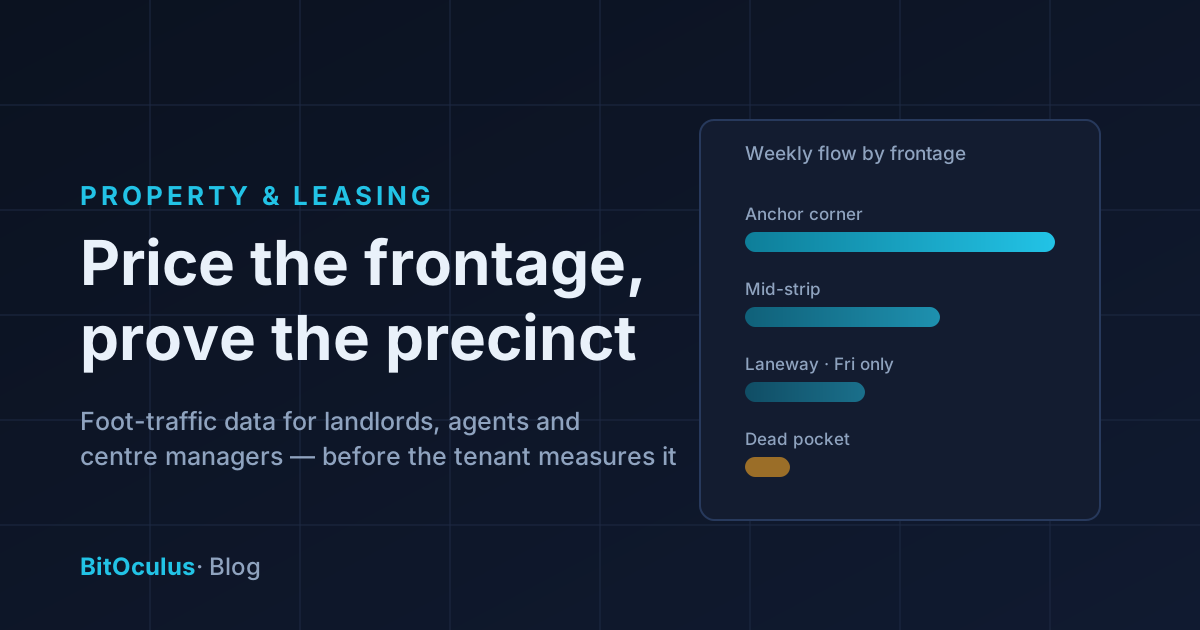
For a landlord, leasing agent or centre manager, foot-traffic data does three jobs: it prices frontage on evidence instead of folklore, it de-risks the leasing conversation by giving prospective tenants a verified number they'd otherwise have to guess (or measure themselves), and it turns tenant-mix and precinct decisions — where the anchor goes, which corner gets the pop-up, what the weekend activation was worth — into measured calls. Retail tenants are already arriving at negotiations with their own counters and their own data. The property side of the table is better served holding better numbers than the counterparty, not fewer.
We've written about site measurement from the tenant's side. This is the other chair: what measured footfall is worth when you own the frontage rather than rent it.
"High foot traffic location" is a claim your tenants can now check
For as long as retail property has been leased, passing trade has been described in adjectives. That worked when nobody could verify it. It's stopping working: a prospective tenant can now mount a small anonymous counting sensor and measure a frontage for two weeks before signing anything — and the sophisticated ones do.
That shift cuts both ways, and the landlord who embraces it first wins twice:
- A verified number leases faster than an adjective. " 8,400 passers-by a week at this frontage, measured hourly, here's the curve" is a fundamentally stronger leasing proposition than "great exposure". It shortens diligence, filters out mismatched tenants early (the café that needs morning traffic won't waste your time on the strip that lives after 5pm), and anchors the rent conversation on your data rather than the tenant's.
- Asymmetry now runs against the unmeasured party. When the tenant has a two-week count and the landlord has impressions, every rent review starts on the back foot. The fix is not to argue with their data — it's to have better data: longer history, every frontage, every daypart.
What a measured precinct lets you do
Beyond the leasing brochure, continuous footfall across a centre or strip is an operating instrument:
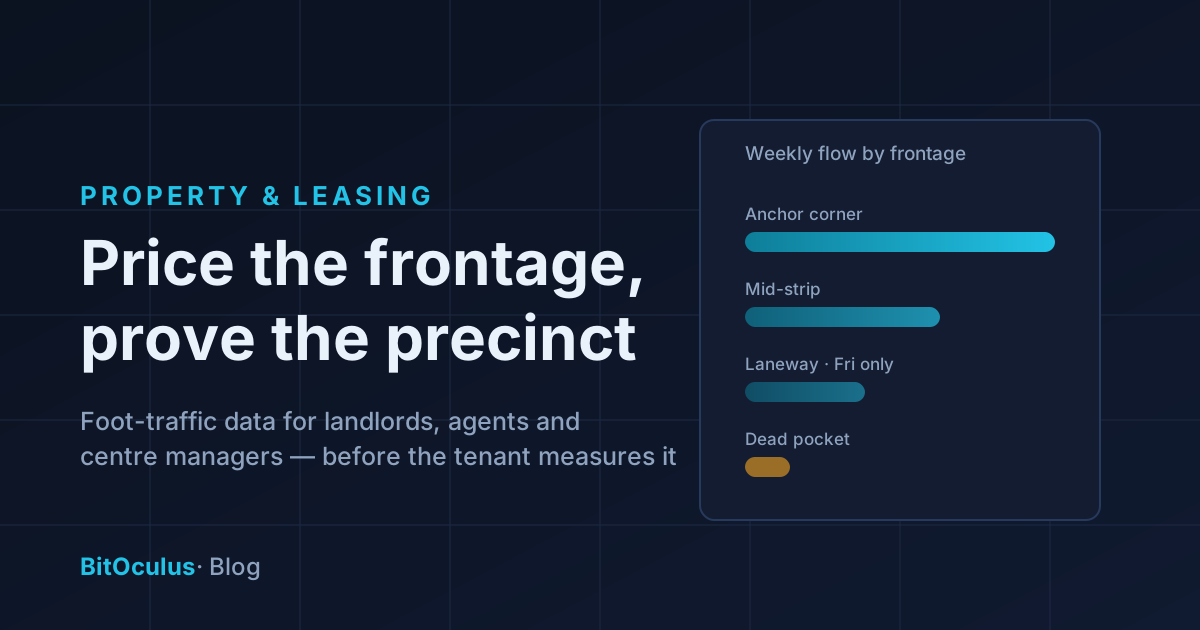
- Price frontage differentially. Flows within a precinct vary enormously — the corner by the escalator, the dead pocket past the food court, the laneway that only works Friday nights. Measured flow supports rents that map to actual exposure, and gives you the evidence when a tenant disputes their corner's worth.
- Make tenant mix a flow decision. An anchor's job is to pull traffic past the specialty stores that pay the higher per-metre rents. Measured, you can see whether the anchor actually does it — how far its gravity reaches, which walkways it feeds, what happened to adjacent frontages when it changed. The same logic scores a pop-up or a mini-anchor experiment in weeks.
- Prove the activation. School-holiday programs, night markets, Christmas installs — precinct marketing spends real money on the claim that it lifts traffic to tenants. A measured baseline turns the claim into a number, which does double duty: it disciplines your own spend, and it becomes marketing collateral to tenants ("the winter festival lifted weekday-evening footfall — here's the chart").
- Give tenants a reason to stay. Sharing each tenancy's frontage data is retention: a tenant who can see their traffic (and what centre programming does for it) is negotiating with you inside your evidence, not against it — and a struggling tenant flagged by falling footfall is a conversation you can have before the vacancy, not after.
Counting a public space without surveilling it
Property owners have a sharper version of the privacy question than retailers: counting happens in common areas, at scale, across many people who never chose to interact with any store. That's precisely the environment where architecture matters. Edge-AI sensors process every frame on the device and discard it in milliseconds — no footage stored or streamed, no faces, no tracking of individuals across the precinct; only anonymous counts and flows leave each sensor. No CCTV-style footage archive exists to secure, subpoena or breach, and because no personal information is collected, most privacy-law obligations don't attach in the first place. (The legal detail.) For a landlord, that's not just compliance hygiene — it's what makes the data shareable with tenants and marketable in leasing without a privacy caveat attached.
Where to start without boiling the precinct
The instinct is to instrument everything; the better play is to measure where decisions are pending:
- The vacancy you're leasing now. Two months of frontage data turns the next negotiation.
- The frontage in dispute. The tenant claiming their corner is dead — measure it, and either fix the flow or price it honestly.
- The activation budget. Baseline the precinct before the next major program so the lift is measurable.
- Then widen to the flow map — anchors, entries, walkways — as the first three pay for the habit.
The through-line of all of it matches where retail property is heading: the buildings that know their numbers — energy, occupancy, footfall — are easier to lease, easier to operate, and easier to defend at valuation. Footfall is the retail-specific layer of that stack, and it's the one your tenants are already measuring from their side of the glass. (The broader spatial-intelligence argument is here.)
Frequently asked questions
How do shopping centres measure foot traffic?
With counting sensors at entrances and along key walkways. Modern edge-AI sensors count anonymously — each frame is processed on the device and discarded, with no footage stored and no individuals identified — and weatherproof units handle open-air strips and entries. Entrance counts give centre-level traffic; walkway and frontage counts give the flow map that supports leasing and tenant-mix decisions.
Can landlords use foot traffic data in lease negotiations?
Yes, and increasingly they must: tenants are arriving with their own measured counts. Verified frontage data supports asking rents, shortens diligence for prospective tenants, and grounds rent reviews in a shared evidence base. The negotiating risk today is asymmetry — being the party with adjectives when the other side has data.
What is foot traffic data worth to a retail landlord?
It compounds across leasing (faster deals, defensible rents priced to measured exposure), operations (tenant-mix and activation decisions scored against baselines), and retention (tenants who see their frontage data — and what centre programming does to it — renew inside your evidence). The cost side is modest: sensors at decision-critical frontages first, widening only as the data pays.
Is counting people in common areas legal?
Anonymous counting — on-device processing, frames discarded instantly, no one identified or tracked individually — collects no personal information, which keeps it outside most privacy-law obligations that attach to CCTV and video analytics. Recording footage of common areas is a different regime entirely. The architecture of the sensor is what makes the difference.
BitOculus measures frontages, entries and walkway flows from weatherproof on-device sensors — verified accuracy, no footage ever stored, and multi-site plans built for portfolios. See a live dashboard, view pricing or talk to the founder.