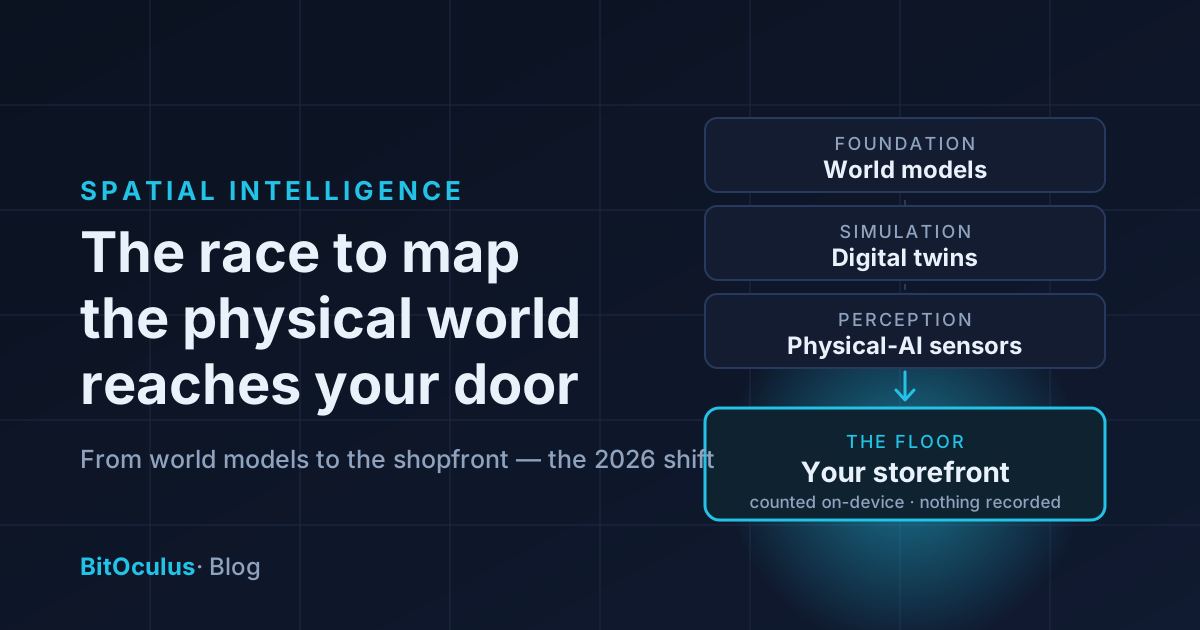
Spatial intelligence — the branch of AI that perceives, maps and reasons about physical space — has crossed from research lab to real market, and it's on track to be worth more than $126 billion within the decade. In 2026 the same stack now powering robots, autonomous vehicles and AI-generated 3D worlds is arriving at the most overlooked place of all: the shopfront. The stores that plug into it first will run on evidence; everyone else keeps guessing.
For most of the last decade, "AI" meant language and pixels — chatbots that write and models that paint. The next wave is different. It's AI that understands where things are, how they move, and what happens when they interact in real space. That capability is what unlocks self-driving cars, warehouse robots and digital twins of entire cities — and it's the same capability that finally lets a physical store see itself the way an online store always has.
The technology that learned to see space
The clearest sign that spatial intelligence has gone mainstream is who's building it. Fei-Fei Li — the researcher who kick-started modern computer vision — now calls spatial intelligence "the next frontier of AI" and founded World Labs to chase it. The company has raised $1.23 billion and, in June 2026, published a functional taxonomy splitting world models into three roles: a renderer that generates space, a simulator that predicts how it changes, and a planner that decides how to act in it (World Labs, TIME).
Strip away the jargon and the idea is simple: these systems hold a persistent, navigable model of physical space, instead of treating the world as a flat stream of pixels. That's the leap that lets a robot approach the same shelf from two angles and find the same object — and it's the same leap that separates counting people from understanding movement through a space. We unpacked that distinction in what spatial intelligence actually means for retail.
A market racing toward $126 billion
This isn't a niche academic interest. The money is moving, fast:
- The geospatial analytics AI market is projected to grow from roughly $45 billion in 2026 to about $126.6 billion by 2035, a 12.7% CAGR (Precedence Research).
- The narrower geospatial intelligence market is forecast to reach $62.9 billion by 2030, up from $37 billion in 2025 (MarketsandMarkets).
- Within that, digital twins and urban-planning applications are the single fastest-growing segment — living simulations of stores, factories and cities that have to be fed by real-world movement data to stay accurate.
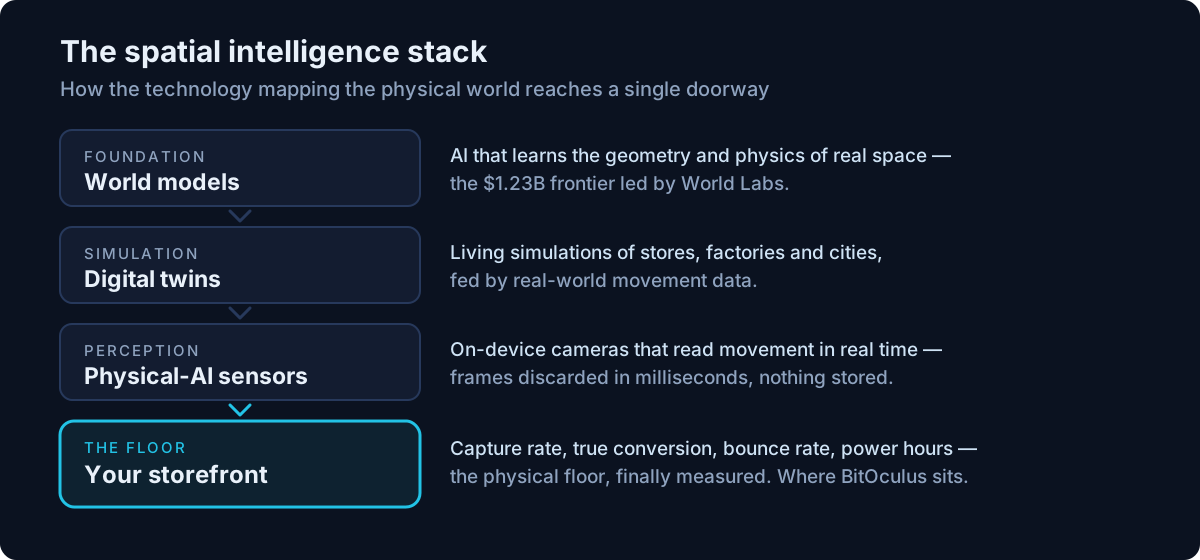
The pattern across all of it is the same. The grand applications at the top — robotics, autonomous driving, city-scale digital twins — all depend on a foundation of perception: sensors that read movement in physical space and turn it into structured data. Without that bottom layer, the models at the top are simulating a world they can't actually see.
Why physical retail is the last great blind spot
Here's what makes retail interesting in this story. The physical store is, by a wide margin, the largest unmeasured space in the economy:
- About 76% of US retail sales still happen in physical stores (2026 retail outlook) — yet that floor is the least-instrumented part of the business.
- 95% of retail executives expect higher operating costs in 2026 (Snowflake), which means getting more out of the traffic, floor space and payroll you already have.
- The retail intelligence market is growing at a 32.3% CAGR through 2031 (The Insight Partners) — one of the fastest curves in enterprise software, riding the same spatial-AI wave.
Every one of those forces points in the same direction: the physical floor can no longer afford to be the one channel in the business that nobody can see. Spatial intelligence is what closes the gap — and it arrives one floor down from the headlines.
From world models to your doorway: the same stack, one floor down
The technology mapping the physical world is a stack, and a storefront sits on the bottom rung of it:
- World models learn the geometry and physics of real space.
- Digital twins turn that into living simulations of stores, factories and cities.
- Physical-AI perception is the sensor layer that reads real movement and feeds everything above it.
- The floor — your doorway — is where that perception layer actually touches a business.
BitOculus is that perception layer for the shopfront. A single weatherproof AI sensor above your door reads the movement of people through your space — who walks past, who comes in, who turns around — and turns it into anonymous, structured data. It's the same fundamental capability driving the rest of the spatial-AI boom, pointed at the one space that matters most to an independent retailer: yours.
What it looks like on your floor
Spatial intelligence is only worth anything if it changes a decision. On a real shopfront, it answers four questions a register never can:
- Capture rate — what share of passers-by your window actually pulls in.
- True conversion — sales divided by real visitors, with staff filtered out and repeat entries deduplicated.
- Bounce rate — the customers who walked in, took one look, and walked straight back out.
- Power hours — when your traffic genuinely peaks, so you roster to the curve instead of the calendar.
We break down all four — with formulas and benchmarks — in the four retail metrics a people counter unlocks. The mechanics of how the counting works, and why accuracy decides whether the numbers can be trusted, are covered in how AI people counting cameras work.
Crucially, this is spatial intelligence without surveillance. Every frame is processed on the device and discarded in milliseconds — no footage is stored or streamed, and no one is identified. Only anonymous counts ever leave the sensor. That's not a compromise on capability; it's what keeps the whole thing on the right side of privacy law (the privacy and legal side of people counting).
Getting on the map before your competitors
Big technology shifts reward the businesses that move while the rest are still watching. The retailers building a spatial-data foundation now will have something to feed every AI system that follows — demand forecasting, automated rostering, store-by-store benchmarking. The ones who wait will be trying to optimise a business they still can't see.
You don't need a robotics lab to get there. You need one sensor above your door, calibrated against ground truth at your entrance, reading capture rate, conversion, bounce rate and power hours within days. BitOculus is onboarding a limited cohort of founding stores right now — hardware and white-glove installation on us, the dashboard free through beta, no contracts and no lock-in.
Frequently asked questions
What is spatial intelligence, in simple terms?
It's AI that understands physical space — where things are, how they move, and what happens when they interact — rather than just text or images. In a store, that means turning the movement of people through your space into anonymous data you can measure and act on.
Is this really the same technology behind robots and self-driving cars?
The foundation is shared. Robotics, autonomous driving and city-scale digital twins all depend on a perception layer that reads movement in physical space. A storefront sensor like BitOculus is that same perception layer, pointed at a doorway instead of a road or a warehouse.
Do I have to store video to benefit from spatial intelligence?
No — and the best implementations specifically avoid it. Edge-AI sensors analyse each frame on the device and discard it immediately, emitting only anonymous counts and movement events. Nothing is recorded, streamed or used to identify anyone.
How does a small store actually get started in 2026?
Fast and cheaply. A single sensor above the door, one cable or Wi-Fi connection, and on-site calibration is enough to start reading the four core metrics within days. There's no infrastructure to build — the spatial intelligence runs on the device itself.
BitOculus brings spatial intelligence to the shopfront from a single sensor above your door: up to 99% verified accuracy, all processing on-device, no footage ever stored. The founding cohort gets hardware and installation on us. Join the waitlist or get in touch.