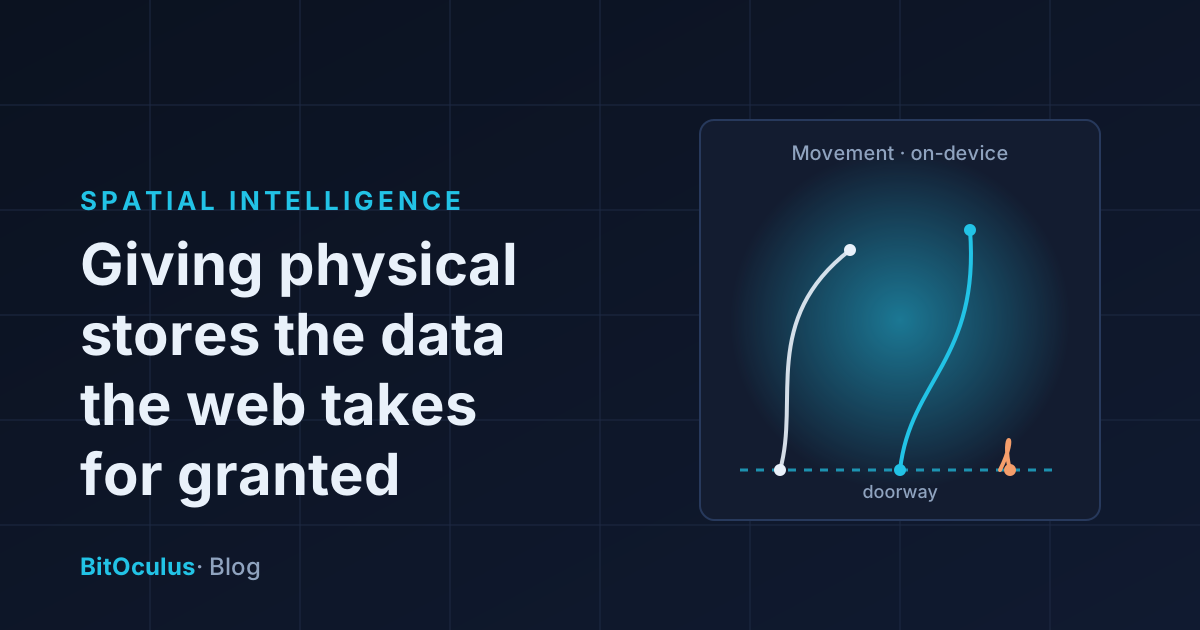
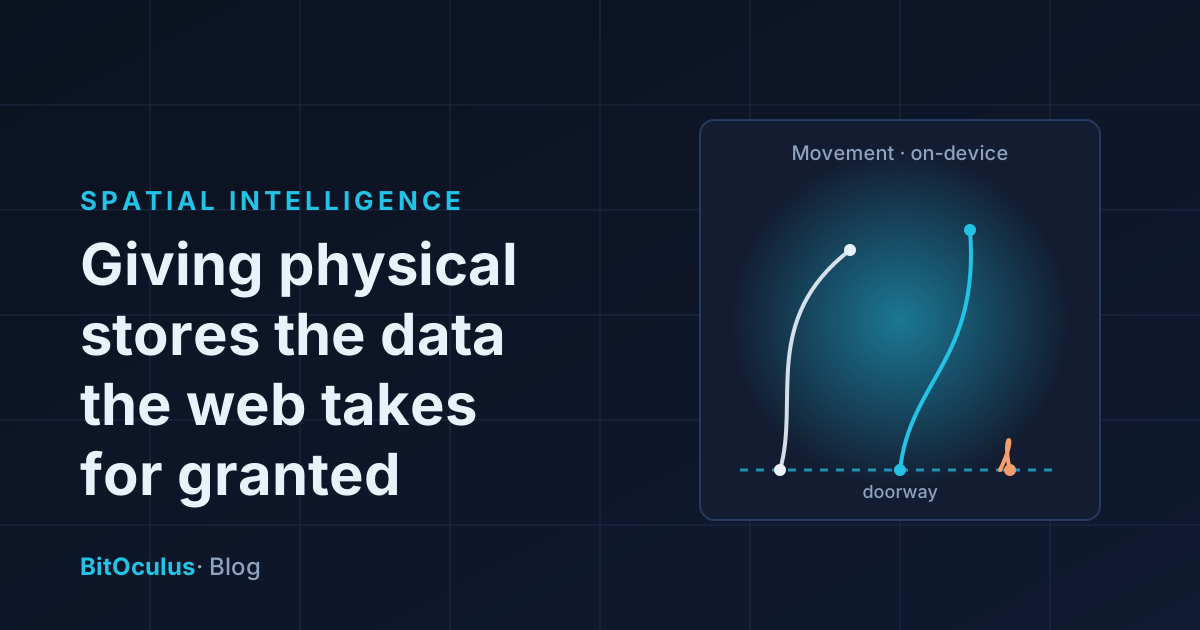
Spatial intelligence is the ability to turn the movement of people through physical space — where they go, how long they stay, what they walk past and what stops them — into structured data you can measure and act on. It's the same advantage e-commerce has had for two decades, finally arriving in the physical store. And in 2026, with most retail sales still happening in person and operating costs climbing, it's becoming the difference between running a store on instinct and running it on evidence.
For twenty years there have been two kinds of retailers. Online stores know everything: every visitor, every bounce, every path to checkout, measured to the decimal. Physical stores know almost nothing — a daily sales total and a gut feeling. Spatial intelligence closes that gap.
What spatial intelligence actually means
The term sounds abstract, but the idea is simple. A physical space — a shopfront, an aisle, a queue, a stretch of footpath outside your window — is full of signal. People approach it, enter it, move through it in patterns, pause at some points and ignore others, and leave. Spatial intelligence is the practice of capturing that movement as anonymous data and turning it into answers.
It's the layer that sits between a raw sensor and a business decision:
- Counting tells you how many people entered.
- Spatial intelligence tells you how many walked past without coming in, where they went once inside, which displays stopped them, when your real peaks hit, and how many turned around at the door.
That's the leap from a number to an understanding of the space itself — and it's only possible now because edge AI can watch a doorway, interpret movement, and discard the footage in milliseconds, all without recording or identifying anyone. (We explain the mechanics in how AI people counting cameras work.)
Why 2026 is the inflection point
Three forces are converging this year that make spatial intelligence move from "nice to have" to "table stakes."
1. Physical retail is still where the money is
For all the headlines about e-commerce, store-based retail accounted for roughly 76% of total US retail sales in 2025 (Colliers, via the 2026 retail outlook). The overwhelming majority of buying decisions still happen on a physical floor — yet that floor is the least-measured part of the business. The bigger the channel, the more expensive it is to keep flying blind.
2. Margins are under real pressure
Retail leaders are bracing for a harder cost environment: in Snowflake's analysis of 2026 trends, 95% of executives anticipate higher operating costs (Snowflake, 2026 retail data trends). When you can't grow your way out of cost pressure, you have to get more out of the floor space, the foot traffic and the payroll you already have. That's precisely the waste spatial intelligence exposes — overstaffed dead hours, underperforming windows, layouts that quietly leak customers.
3. The market is racing to catch up
This isn't a fringe bet. The retail intelligence market is projected to grow at a 32.3% CAGR from 2025 to 2031 (The Insight Partners) — one of the fastest growth rates in enterprise software. It rides the same wave as agentic AI in retail, which Deloitte sizes at $8.5 billion in 2026, climbing toward $35–45 billion by 2030. Retailers who build a spatial data foundation now will have something to feed those AI systems; those who don't will be optimising a business they still can't see.
From data to decisions: what spatial intelligence unlocks
The point of spatial intelligence isn't the data — it's the decisions the data makes obvious. Once you can read the space, four questions every store owner has guessed at suddenly have numeric answers:
- How good is your shopfront at pulling people in? That's your capture rate — entries divided by passers-by — and you can only measure it if you count the street, not just the door.
- What share of visitors actually buy? True conversion, with staff filtered out and repeat entries deduplicated, so the number is trustworthy enough to act on.
- Who walked in and immediately walked back out? Bounce rate is the earliest warning that something inside — a queue, a layout, a first impression — is leaking money.
- When does your traffic actually peak? Power hours let you roster to the real curve instead of the calendar.
We go deep on all four in the four retail metrics a people counter unlocks. The common thread: each one is a spatial question that a sales report can never answer, because the register only sees the transactions that happened — never the ones that didn't.
Where BitOculus sits at the frontier
Plenty of vendors will sell you a counter. What puts BitOculus at the front of the spatial-intelligence curve is how it counts and what it does with what it sees.
- It reads the whole space, not just the threshold. A weatherproof, outdoor-capable sensor counts the people who walk past your window as well as those who come in — which is the only way to measure capture rate, and something beam and thermal counters physically can't do.
- It understands movement, not just crossings. Direction, dwell, U-turns and bounces come from tracking anonymous paths through the space, with up to 99% verified accuracy, staff filtered out and repeat visitors deduplicated.
- It's spatial intelligence without surveillance. Every frame is processed on-device and discarded in milliseconds. No footage is ever stored or streamed, and no one is identified — which is exactly what keeps it on the right side of privacy law. (See the privacy and legal side of people counting cameras.)
- It's verified at your door. A datasheet accuracy number means nothing until it holds at your entrance, in your light, with your crowds. BitOculus calibrates against ground truth on site, as standard.
That combination — outdoor-aware, movement-level, accurate, and private by design — is what turns a people counter into genuine spatial intelligence for the shopfront.
Frequently asked questions
What is the difference between people counting and spatial intelligence?
People counting gives you a number — how many entered. Spatial intelligence interprets movement through the space: who walked past without entering, who turned around, where people went and when traffic peaked. Counting is the raw input; spatial intelligence is the understanding built on top of it.
Does spatial intelligence require storing video?
No — and the best implementations specifically avoid it. Edge-AI sensors like BitOculus analyse each frame on the device and discard it immediately, emitting only anonymous counts and movement events. Nothing is recorded, streamed or used to identify anyone.
Why does spatial intelligence matter more in 2026?
Because the pressures all point the same way: about 76% of retail sales still happen in physical stores, 95% of executives expect higher operating costs, and the retail intelligence market is growing at a 32.3% CAGR. Stores can no longer afford to be the only unmeasured channel in the business.
How quickly can a store start using spatial intelligence?
Fast. A single sensor above the door, one Power-over-Ethernet cable or Wi-Fi connection, and on-site calibration is enough to start reading capture rate, conversion, bounce rate and power hours within days.
BitOculus brings spatial intelligence to the shopfront from a single sensor above your door: up to 99% verified accuracy, all processing on-device, no footage ever stored. The founding cohort gets hardware and installation on us. Join the waitlist or get in touch.