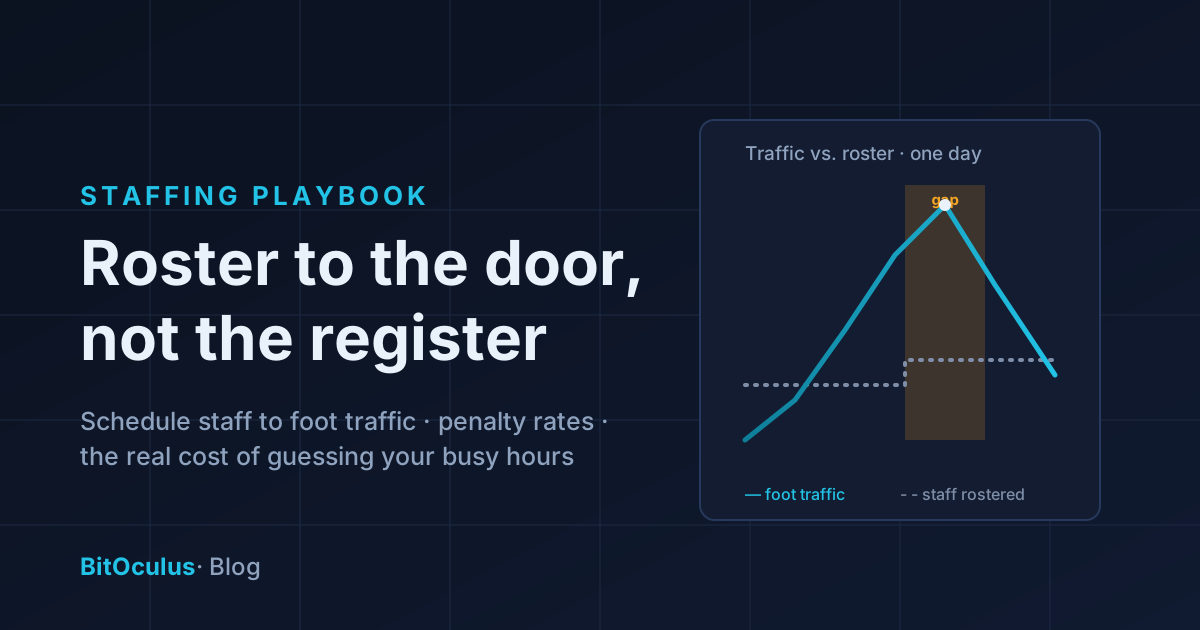
Most stores build next week's roster from last week's sales. But your point of sale can't see the customers who walked in and left empty-handed, or the ones who glanced through the window and kept walking — so it quietly overstaffs the quiet hours and under-serves the busy ones. Scheduling to foot-traffic data instead closes that gap: a peer-reviewed study of 41 stores found that eliminating peak-hour understaffing raised profitability by around 7% and recovered roughly 8.6% of lost sales (Mani, Kesavan & Swaminathan, Production and Operations Management, 2015).
Labour is the single largest cost you actually control. Get the timing wrong and you pay twice — once for the staff standing around at 10am, and again for the sales you never made at the 5pm rush. This guide explains why sales are the wrong number to roster against, what the research says it costs you, and how to build a roster around your door instead — with the Australian wage rules that make the maths sharper here than anywhere else.
Your roster is built on the wrong number
Sales tell you what happened at the register. They say nothing about how many people were in the store, when they were there, or how many left without buying. Two very different days can post identical takings: one where 60 people came in and 30 bought, and one where 200 came in and 30 bought. The first is a healthy day. The second is a staffing emergency — 170 people who came in and weren't converted — and your POS reports them as the same.
Roster off sales and you inherit that blindness. You'll staff to revenue, which lags traffic by hours and hides every missed opportunity inside it. What you actually need is a headcount of the people walking past and walking in, hour by hour — the same live traffic and conversion picture an online store takes for granted. That's the gap a people counter fills, and it's why the power-hours metric is worth building a roster around.
Labour is your biggest lever — and in Australia it's dearer than most advice assumes
Almost every scheduling article you'll read is written for US or UK labour economics. Australia is a different game. Labour is the largest controllable operating cost in retail — on the order of 40% of operating costs, with a wage share of sales that runs higher than in comparable markets (Productivity Commission). And when those hours fall matters as much as how many there are, because our award system prices time differently through the week.
Under the General Retail Industry Award, ordinary hours carry penalty loadings of 125% after 6pm on weekdays and on Saturdays, 150% on Sundays, and 225% on public holidays, on top of casual loading (Fair Work Ombudsman) — and every hour also attracts 12% compulsory superannuation (ATO). A shift rostered into a slow Sunday afternoon isn't just an idle hour; it's an idle hour billed at 150% plus super. In Australia, mis-timed labour is punished harder than almost anywhere — which is exactly why timing the roster to real demand pays back faster here.
The evidence: nearly every store is understaffed exactly when it's busiest
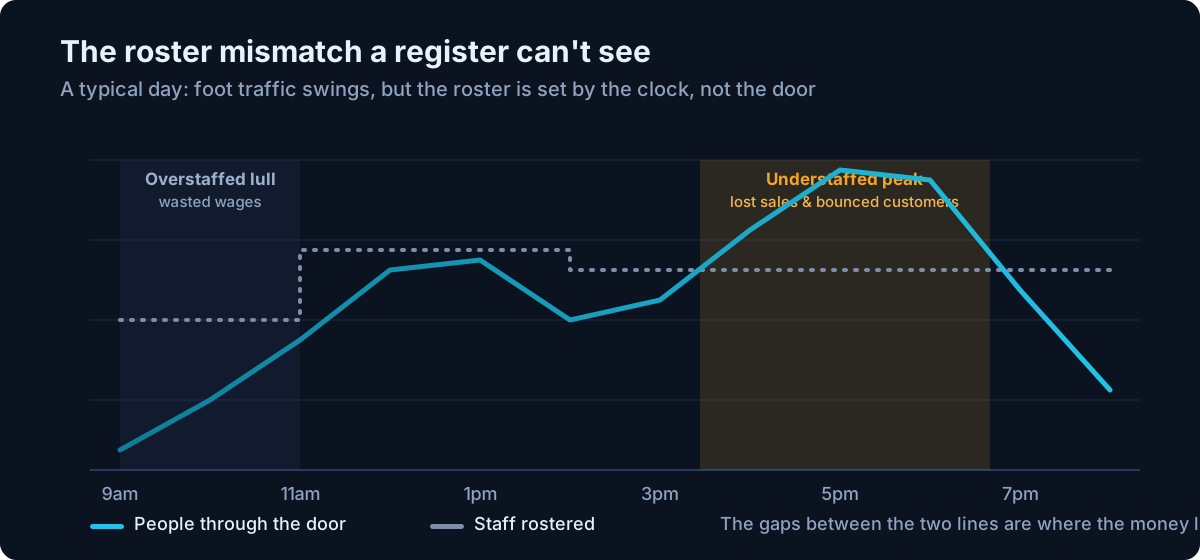
This isn't a hunch. When researchers matched hourly traffic, sales and labour data across 41 stores of a large chain, they found every single store was systematically understaffed during its peak-traffic hours — and overstaffed during the lulls (Mani et al., 2015). The pattern was universal, not the exception.
The cost of that mismatch is real money. Fixing it — moving effort into the peaks — was worth about 7% of profit and 8.6% of sales in the study. And crucially, the authors tested a realistic version: not perfect hindsight, but a one-week-ahead traffic forecast of the kind any store with a people counter can produce. Even then, the profitability gain held at roughly 4.5% — a number you can actually capture, not a theoretical ceiling.
Why does the floor coverage move sales so much? Because traffic doesn't convert on its own. A separate study of apparel stores showed that staff moderate how effectively foot traffic turns into sales — add people to a thinly-covered floor and each extra visitor is worth less, because no one is there to serve them (Perdikaki, Kesavan & Swaminathan, M&SOM, 2012). Understaff the peak and you don't just tire out your team; you depress true conversion and push up your bounce rate as customers hit a queue, find no one to help, and leave. It's the same lesson Wharton drew from years of retail data: slashing store payroll to save cost routinely backfires, because it cuts into the sales the payroll was there to make (Knowledge@Wharton).
Read the traffic curve, not the clock
Rostering to foot traffic is a short, repeatable loop:
- Collect at least four weeks of traffic data, broken into 15-minute intervals. One or two weeks is too noisy; four weeks lets you separate the real pattern from one-off spikes and weather.
- Find your true day-parts. Retail peaks commonly cluster around late morning, mid-afternoon and early evening, with weekend afternoons the heaviest — but yours will be specific to your street. Measure it; don't assume it.
- Overlay your current roster on the curve. The mismatches jump out: the over-covered opening hour, the thin patch right as the afternoon peak builds, the closing shift that outlasts the last customer.
- Watch capture rate, not just entries. If you can count the street as well as the door, a peak where capture rate sags — lots of people passing, few coming in — is often a staffing signal: a visibly busy, under-served store turns people away at the glass.
Most owners find double-digit payroll waste in the first week of looking. The fixes are usually obvious once the curve is in front of you.
Build the roster around the door
The goal isn't to add hours — it's to move them to where they earn:
- Staff up before the peak, not into it. Bring the extra person on ~30–60 minutes ahead of the rush so the floor is ready when it lands, not scrambling once it has.
- Redeploy the lulls. The over-covered morning is your budget for the under-covered peak. Shifting hours is cost-neutral; it just requires knowing which hours to shift.
- Protect the peak first. When you have to trim, trim the quiet edges of the day, never the busiest hour — that's the one stretch where an extra pair of hands directly converts traffic to sales.
- Mind the loadings. In Australia, a Sunday or public-holiday peak is expensive coverage, so it's the last place you want to be caught either short (lost sales at a premium) or over (idle hours at 150–225%). Precise timing matters most exactly when the clock is dearest.
None of this works on gut feel, because gut feel is systematically wrong in both directions — it pads the dead hours and starves the peaks. It only works with a measured curve.
What one mis-timed peak actually costs
Numbers make it concrete. Take a café turning over A$18,000 a week. The peer-reviewed research suggests peak-hour understaffing can cost up to ~8.6% of sales; take the conservative, forecast-based figure of around 4.5% and that's roughly A$800 a week — about A$42,000 a year walking out the door because the counter is three-deep and one barista short at 8am.
Now the fix. Often it costs nothing: you pull a slow mid-morning shift and redeploy those hours into the breakfast rush. Where you do add coverage — say 15 peak hours a week at a casual rate with loading and super, well under A$700 — the recovered sales still clear it comfortably, and you've improved service at the moment customers judge you on it. (These figures are illustrative — the point is the direction, and it holds across boutiques, cafés and studios alike. Run it on your own revenue and award rates.)
The verticals differ only in the details. A café lives or dies on covering the morning and lunch rushes; a boutique on weekend afternoons; a gym or studio on the pre-work and post-work class windows. In every case the discipline is identical: count the demand, then staff to it.
Get the insight without surveilling anyone
There's an obvious objection to any of this: does measuring the floor mean putting your customers — and your staff — under a camera? It doesn't have to. A privacy-first sensor counts people entirely on the device: it detects and counts bodies as anonymous shapes, then discards every frame in milliseconds. No video is stored or streamed, no faces are captured, and no one is identified — only the anonymous counts ever leave the sensor. You get the traffic curve you need to roster well without creating footage that could leak, and without the trust problem that comes with pointing a recording camera at your team (the privacy and legal side).
That's the whole idea behind spatial intelligence for the shopfront: see everyone, identify no one. The output isn't surveillance — it's the same operational clarity an online store has always had, finally pointed at your floor.
Frequently asked questions
How do I schedule retail staff based on foot traffic?
Collect at least four weeks of foot-traffic data in 15-minute intervals, identify your real peaks and lulls by day of the week, then overlay your roster on that curve and shift hours out of the quiet stretches and into the peaks. Staff up shortly before each peak rather than into it, and re-check the curve each season as your traffic pattern shifts.
What's a good labour cost percentage for a store or café in Australia?
It varies by format. Retailers commonly aim for labour in the region of 25–35% of sales, and Australian hospitality benchmarks put cafés and quick-service around 20–25% with full-service higher. Because Australian penalty rates and 12% super push on-costs up, the ratio matters less than the timing: the same total wage bill earns far more when it's aligned to when customers are actually in the store.
Is understaffing or overstaffing worse?
They cost you in different ways. Overstaffing wastes wages you can see on the payroll; understaffing costs sales you never record, which makes it the more dangerous of the two because it's invisible on a POS. The research is blunt about it — nearly every store studied erred toward understaffing at its peak, leaving profit on the table. The aim isn't to pick one, it's to match staffing to demand so you do neither.
How much foot-traffic data do I need before I change my roster?
Around four weeks. That's enough to see a stable weekly pattern and filter out one-off spikes, weather and public holidays. After that, keep the sensor running — traffic patterns drift with seasons, local events and your own marketing, and the roster should drift with them.
Can I measure foot traffic for staffing without recording my customers?
Yes. Edge-AI sensors process every frame on the device and discard it instantly, emitting only anonymous counts — no footage, no faces, no identification. You get the hour-by-hour traffic curve you need to roster well while collecting no personal information at all, which also keeps you clear of most privacy obligations.
BitOculus measures your foot traffic — including the passers-by your register never sees — from a single sensor above the door, counted on-device with no footage ever stored. The founding cohort gets hardware and white-glove installation on us. Explore a live dashboard or join the founding cohort.