For a museum, gallery, library or venue, visitor counting does a job retail never asks of it: the number itself is a deliverable. Visitation is what funding bodies assess, boards govern by, and annual reports lead with — and it's still, in many venues, produced by a volunteer with a clicker, a ticket-count that misses free entry, or an estimate nobody can defend. Accurate, continuous, anonymous counting turns that number from an approximation into evidence — and the same data quietly answers the programming, staffing and safety questions in the same pass.
Here's what changes when a cultural venue counts properly: the reporting, the exhibition decisions, and the operational layer underneath.
The visitation number is infrastructure, not admin
Commercial retail measures traffic to make money; cultural venues measure it to exist. Grant acquittals ask for visitation. Council and government funders compare it year on year. Sponsors buy exposure denominated in it. Boards set strategy against it. For a venue, the count carries weight that a shop's never has to — which makes the standard ways of producing it strikingly fragile:
- Ticketed counts miss everyone who enters free — often the majority in mixed-access venues, and precisely the community-access audience funders care most about.
- Clicker counts depend on a stationed human, evaporate at busy moments, and can't run continuously.
- Estimates ("we multiply Saturday by…") survive until the first funder who asks a follow-up question.
A sensor above each public entrance replaces all three with a continuous census: every entry and exit, timestamped, all opening hours, every day — the same edge-AI counting that retail uses, with up to 99% verifiable accuracy and the verification done at your own door. When the acquittal asks "how do you know?", the answer is a method statement, not a shrug.
Counting without surveilling — in a sector where it's non-negotiable
Cultural venues sit at the sharp end of the surveillance question: public institutions, children on school visits, community trust as the core asset. Pointing recording cameras at visitors to produce statistics is exactly the wrong trade. This is where the architecture matters: an edge-AI sensor processes each frame on the device and discards it in milliseconds — no footage stored or streamed, no faces, no one identified, only anonymous counts leaving the sensor. No personal information is collected at all, which for a public institution isn't just easier compliance — it's a sentence you can print in the annual report and defend to any stakeholder.
Beyond the headline number: what the curve tells a venue
The funder sees the total; the venue should read the shape. The same hourly data that produces the annual figure answers the questions programming and operations argue about:
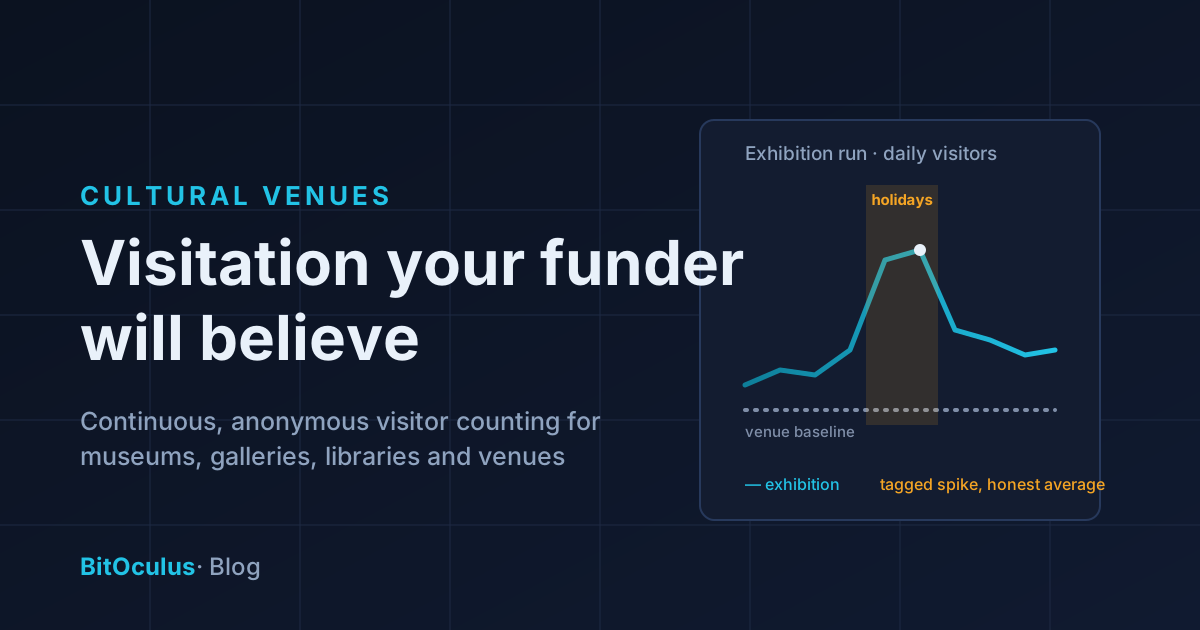
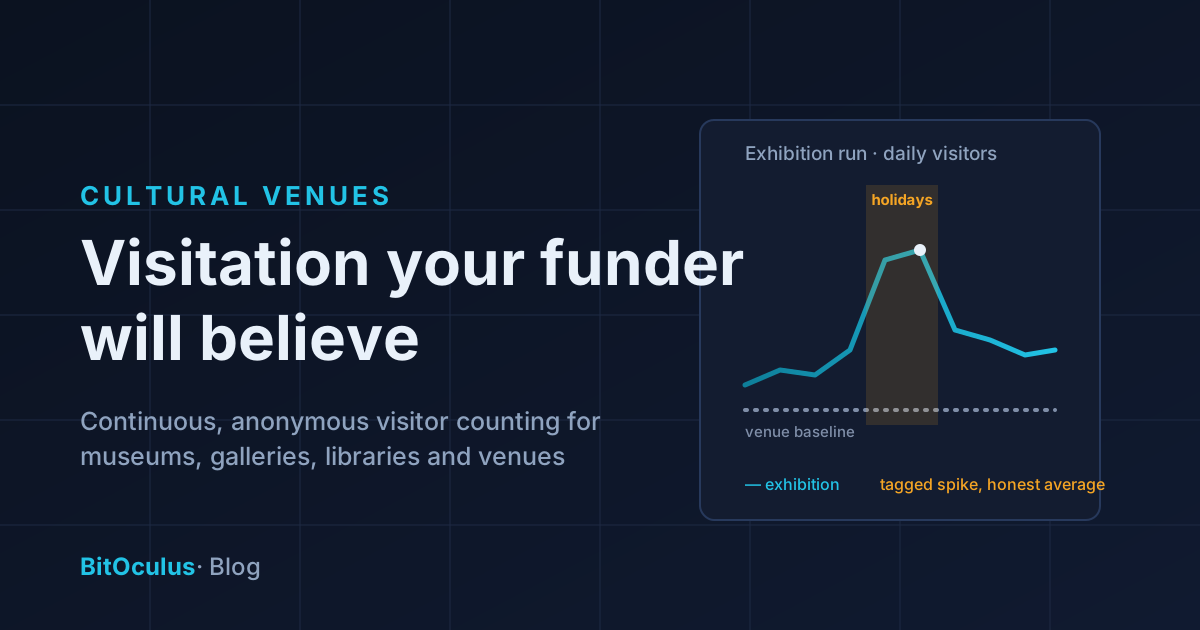
- Did the exhibition actually pull? Visitation during the run versus your baseline — with school-holiday and event weeks tagged so the comparison is honest, the same event-distortion discipline pop-ups use — is the measured verdict on programming bets. Per-exhibition curves accumulate into institutional memory: what your audience actually turns out for, by season.
- When do visitors really come? The measured power hours tell you whether Sunday afternoons deserve more invigilators, whether the late-night opening earns its staffing, and whether the quiet Tuesday morning is the right home for the seniors' program — rostering to the curve matters no less when the staff are invigilators and educators.
- How full is the building right now? For popular exhibitions, workshops and event nights, live occupancy with a capacity alert is the difference between managing comfort and safety proactively and discovering the crush from the complaints. It also makes "quiet hours" for sensory-sensitive visitors a published, provable promise rather than a hope.
- What did the foyer, shop and café capture? Venues with commercial corners inherit the retail questions too — what share of visitors the shop converts, whether the café matches the visitation peaks — and the same sensors answer them.
The funding case writes itself from the data
The compounding return arrives at submission time. A venue with continuous, method-documented visitation can:
- Report trends, not snapshots — year-on-year growth with clean like-for-like comparisons, per-program attribution ("the free-Friday initiative lifted weekday visitation"), demonstrated reach across access initiatives.
- Answer the efficiency questions — visitors per opening hour, per exhibition dollar, per staffed shift — the ratios that make a grant case comparable and credible.
- Show operational maturity. Funders read a measured venue as a well-run one. The counting method itself — accurate, continuous, privacy-first — becomes part of the institutional-competence story.
The pattern mirrors what we've argued for landlords: when your counterpart decisions are made on your numbers, owning better numbers is strategy, not admin.
Frequently asked questions
How do museums and galleries count visitors accurately?
With sensors at each public entrance counting entries and exits continuously across all opening hours. Modern edge-AI counters reach up to 99% accuracy (verified on site), run unattended, capture free-entry visitors that ticket counts miss, and count anonymously — frames are processed on the device and discarded, so no footage of visitors ever exists.
What visitor data do funding bodies want from cultural venues?
Typically headline visitation with year-on-year comparison, and increasingly the substance behind it: methodology, per-program or per-exhibition breakdowns, and evidence of reach (free access, community programs, school visits). Continuous measured counting supports all of it — and survives the follow-up questions that estimates and clicker counts don't.
Can visitor counting work in venues with free entry?
Free-entry venues are where sensor counting matters most — there's no ticket record to fall back on. Door sensors count every visitor regardless of how they entered, which is precisely the community-access audience that grant acquittals ask venues to demonstrate.
Is people counting appropriate around children and school groups?
Anonymous edge-AI counting is designed for exactly these environments: no recording, no faces, no identification — each frame is analysed on the device and discarded in milliseconds, and only aggregate numbers leave the sensor. No personal information is collected from any visitor, adult or child, which is what makes continuous counting defensible in public institutions.
BitOculus gives cultural venues funder-grade visitation — continuous, verified, privacy-first counting at every entrance, with live occupancy and capacity alerts for the busy nights. Explore a live dashboard or talk to the founder.