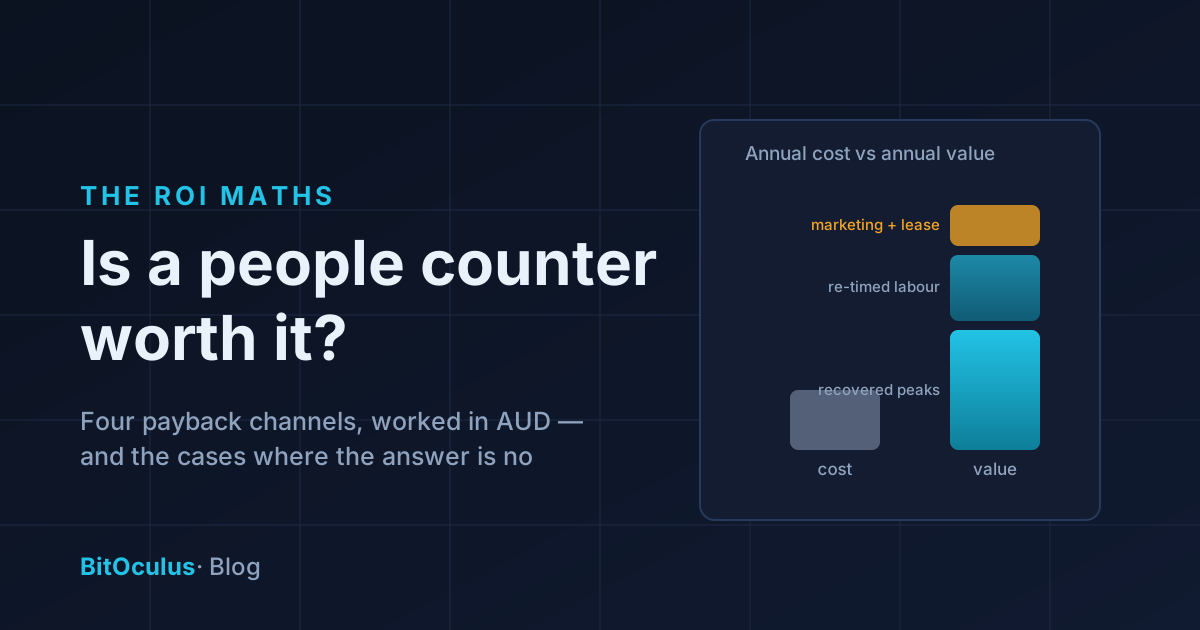
A people counter earns its keep through four channels: labour hours re-timed from dead zones to peaks, sales recovered from understaffed rushes, marketing spend reallocated from tactics that don't lift traffic to ones that do, and negotiating evidence at lease time. For a typical small store, the labour channel alone usually covers the subscription; the peer-reviewed estimate for fixing peak understaffing — around 4.5% of sales using realistic forecasts (Mani, Kesavan & Swaminathan, 2015) — dwarfs what any counter costs. The honest answer to "is it worth it" is a payback calculation, so this post is mostly arithmetic.
We'll work a conservative example in Australian dollars, then cover the cases where a counter genuinely isn't worth it — because a tool sold as universally positive should tell you when it's not.
The cost side, without the asterisks
People-counting pricing has two shapes — hardware upfront plus software, or everything folded into one subscription — and the buyer's guide covers the traps in comparing them. For ROI purposes the only number that matters is all-in annual cost: sensor, installation, calibration, software, and replacement risk. Get that number from any vendor you're considering; it's the denominator of everything below. (BitOculus folds hardware into the plan — pricing here — with installation included for the founding cohort, so the all-in number is the advertised number.)
Call the all-in cost C. The question is how many weeks the four channels take to cover it.
Channel 1: labour, re-timed
This is the channel with the strongest evidence and the fastest payback. The research is blunt: across 41 stores studied, every one was understaffed at its traffic peaks and overstaffed in the lulls — and correcting the mismatch with a realistic one-week-ahead traffic forecast improved profitability by about 4.5% (Mani et al., 2015). The mechanism runs through service: on a thin floor, each additional visitor converts worse (Perdikaki et al., 2012).
Note what this channel isn't: it isn't cutting hours. Most of the gain comes from moving existing hours out of measured dead zones and into peaks — cost-neutral on the payroll, positive on the register. In Australia the timing precision is worth more again, because weekend and evening hours carry 125–225% penalty loadings plus 12% super (Fair Work Ombudsman, ATO) — a mis-timed premium hour is the most expensive mistake on the roster. The full staffing playbook is here.
Channel 2: the peaks you stop fumbling
Understaffed peaks don't just idle wages — they hand back demand you already won: the customer who left the queue, the shopper nobody could serve, the bounce at the door. The same study put the sales left on the table at up to 8.6%; even a fraction of that, recovered at your busiest hours, is the largest line in the whole calculation for most stores.
Channel 3: marketing spend that has to prove itself
Without a traffic baseline, every campaign "kind of worked". With one, each promotion, event or ad burst either lifted entries against baseline or it didn't — and the ones that didn't stop getting budget. This channel is harder to put a universal number on, but it has a distinct character: it doesn't add revenue so much as it stops recurring waste, and for a store spending a few hundred dollars a month on local ads, killing the ineffective half is real money every single month. (How to run traffic tactics as experiments.)
Channel 4: evidence, banked
The quiet channel: a continuous frontage count becomes an asset at every negotiation. Rent reviews argued with a year of traffic data instead of impressions; a site decision made on measured footpath numbers instead of an agent's adjectives; an expansion forecast built from your own measured capture and conversion ratios. It pays rarely but in large, lease-sized increments.
The worked example
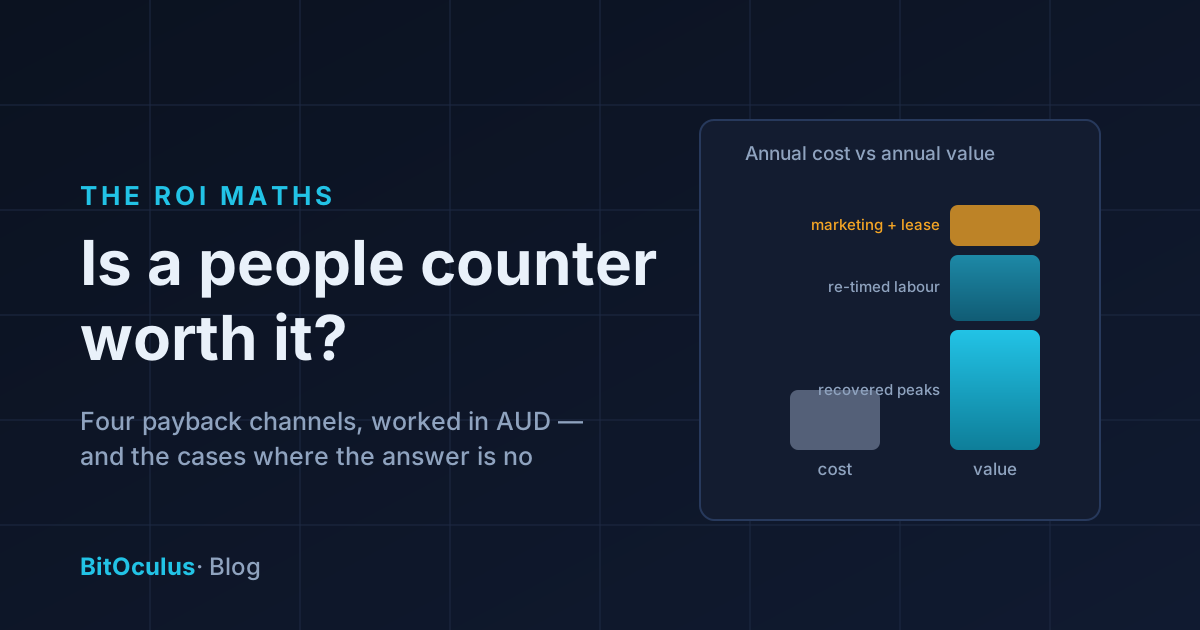
Take a store turning over A$12,000 a week (~A$620k a year) — a modest boutique or café.
- Recovered peak performance. The study's conservative, forecast-based figure is ~4.5% of profit-relevant sales; be more conservative still and assume the store captures just 1% of revenue from better-timed coverage: about A$120 a week, A$6,200 a year.
- Marketing efficiency. If measurement lets you cut or redirect just A$100 a month of spend that demonstrably doesn't lift traffic: A$1,200 a year.
- Lease evidence. Unpriced here — call it insurance that occasionally pays out large.
That's roughly A$7,400 a year of value against an all-in people-counter cost that, for a single-door store on a hardware-included plan, runs well under that. Even if you halve every assumption, payback lands within months, not years. (Illustrative figures — the point is that the conservative case clears the bar comfortably. Run it on your own revenue; every input above is one you'll be able to measure within a month of installing.)
When a people counter is not worth it
Credibility demands the other list:
- You won't act on it. The counter creates options — a roster to re-time, a window to test, a campaign to kill. If nothing will change regardless of what the data says, the subscription buys you charts.
- Appointment-driven businesses. If nearly all visitors book ahead (a salon, a clinic, a studio running on classes), your calendar already is your traffic curve. The exception is walk-in-hungry locations wanting to measure the footpath they're not converting.
- Traffic isn't the constraint. If you're at capacity every open hour, measure nothing and open a second site — then measure the new frontage before signing.
- The data would be too coarse to trust. A cheap counter without staff filtering or deduplication produces numbers you'll learn to ignore — worse than nothing, because you paid for it. If the budget only stretches to a beam counter, understand what it can't tell you before buying.
Frequently asked questions
How quickly does a people counter pay for itself?
For most single-site stores the payback window is months. The labour channel arrives first — dead-zone hours re-timed into peaks within the first few weekly rosters — followed by recovered peak sales. The conservative worked case above (1% of revenue from better peak coverage plus modest marketing efficiency) clears a hardware-included subscription several times over in year one.
What ROI can I expect from foot-traffic analytics?
The best-evidenced figure is the staffing effect: roughly 4.5% profitability improvement from fixing peak understaffing with realistic traffic forecasts, with up to 8.6% of sales identified as lost to under-covered peaks in the underlying study. On top sit marketing-spend efficiency and negotiating leverage at lease time, which vary by store but compound over years.
Is a people counter worth it for a small independent store?
Often more so than for a chain — a chain averages its mistakes across hundreds of sites, while a single-site owner eats every mis-timed roster and wasted ad dollar personally. The prerequisite isn't size; it's willingness to change the roster, the window or the marketing when the data disagrees with the gut.
What does a people counting system cost?
It depends on the pricing model: hardware-upfront systems stack a per-door sensor cost, installation and a software fee; hardware-included subscriptions fold it into one price. Compare all-in first-year cost across vendors — the buyer's guide lists the hidden line items to ask about, and BitOculus pricing is here.
BitOculus is a privacy-first people counter with hardware always included — up to 99% verified accuracy, street and door counting, staff filtered, everything processed on-device with no footage ever stored. Run the ROI maths on your own store: explore a live dashboard or talk to the founder.