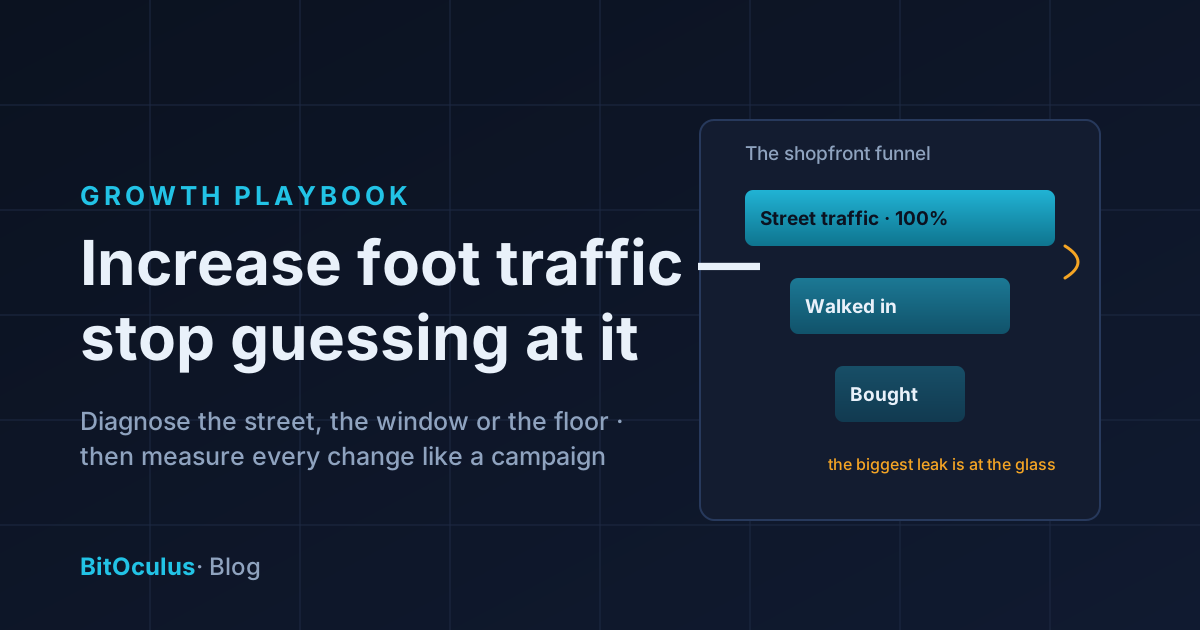
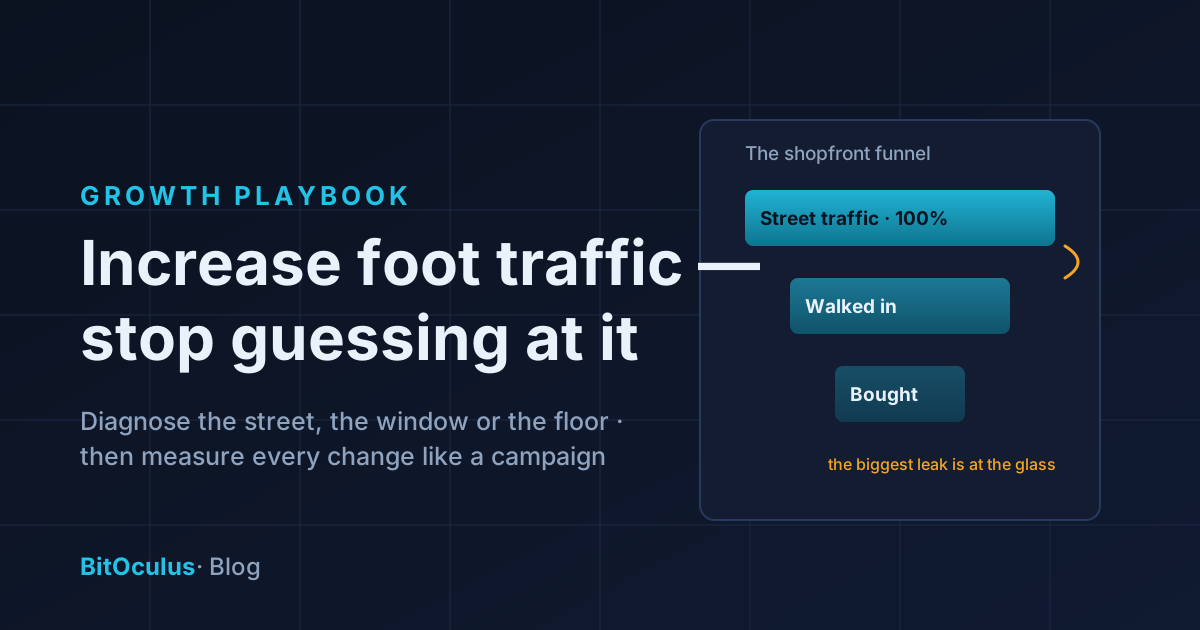
The reliable way to increase foot traffic is to treat your shopfront as a funnel — street traffic → people who notice you → people who walk in — measure where it leaks, fix the biggest leak first, and re-measure after every change. Most stores skip the measuring and jump straight to tactics: a sandwich board, a sale, a social post. Some of those work. But without a baseline count of who's already walking past and walking in, you can't tell which ones — so the budget keeps going to whatever feels like it worked.
This guide walks through the funnel stage by stage: how to find out whether your problem is the street, the window or the doorway, which tactics actually move each stage, and how to run every change as an experiment instead of an act of faith.
Why most foot-traffic advice doesn't stick
Search "how to increase foot traffic" and you'll get listicles: host an event, refresh the window, run a promotion, partner with the café next door, post more. None of it is wrong. The problem is that it's unranked — it treats a store nobody walks past and a store everybody walks past but nobody enters as the same patient.
They're opposite problems. The first store has a street problem: not enough people within sight of the door. The second has a window problem: plenty of passers-by, but nothing stops them. Prescribing the same tactics to both wastes money on at least one of them.
Online stores solved this decades ago. Nobody increases e-commerce revenue by "doing more marketing" in the abstract — they look at the funnel, find the stage with the worst drop-off, and attack that. Your shopfront has the same funnel; it's just never been measured. That's the core idea behind spatial intelligence for retail: give the physical store the same visibility the website already has.
First, find out which problem you actually have
The shopfront funnel has three numbers, and you need all three before spending a dollar on tactics:
- Street traffic — how many people pass within sight of your shopfront per hour.
- Capture rate — what share of those passers-by come in. Entries ÷ passers-by.
- Traffic curve — when your entries actually happen, by hour and day.
A sensor that can see the street as well as the door gives you all three from day one — it's the capture-rate measurement that beam and thermal counters physically can't do, because they only see the threshold. (If you're wondering how a camera can count the street without recording anyone, here's how edge-AI counting works.)
Two weeks of data is enough to make the diagnosis:
- Low street traffic, decent capture rate → your shopfront is doing its job; there just aren't enough people walking past. Your money belongs off-site: local search, social, partnerships, events that give people a reason to make the trip.
- Healthy street traffic, low capture rate → this is the most common finding, and the cheapest to fix. Hundreds of people already walk past every day; the window, signage or entrance isn't converting them. Your money belongs at the glass.
- Good capture, but peaks you didn't expect → your traffic is fine and mis-timed. The fix is operational — opening hours, staffing and promotions aligned to the real curve. (We've covered rostering to the traffic curve in depth.)
As a rough bearing: for street-front retail, single-digit capture rates are common and the strongest shopfronts do multiples of that. The absolute benchmark matters less than your own trend — a capture rate that jumps after a window change is proof the change worked, whatever the neighbour's number is.
Fixing a window problem: the highest-ROI metre of your store
If the diagnosis is a low capture rate, you have the good version of the problem — the audience already exists, and you don't have to pay to reach them. The passers-by are the cheapest marketing channel you will ever have: they're local, they're on foot, and they're already outside your door.
Work the glass like a landing page:
- One message, readable in three seconds. A passer-by gives your window about the length of a stride-past. Cluttered windows read as noise; a single strong offer or product story reads as a reason to stop.
- Change it on a schedule. A static window goes invisible to regulars within weeks — the people who pass daily stop seeing it. Rotate the display and watch whether capture rate responds; now the rotation cadence is a measured decision, not a chore.
- Light it after dark. If your street traffic runs into the evening and the window goes dim at 5pm, you're dark during measurable demand. Your own traffic curve will tell you whether evening passers-by exist before you pay for the lighting.
- Fix the threshold. Doors that look closed, steps that aren't obvious, music or smell that stops at the door — small frictions show up as people who slow down, look, and keep walking. A sensor that detects U-turns and pass-bys makes this visible.
Each of these is a hypothesis. The capture rate before and after is the verdict.
Fixing a street problem: buy traffic like an online store buys clicks
If genuinely too few people pass your door, tactics at the glass can't save you — you need to generate trips. The classics still work: Google Business Profile kept ruthlessly up to date, local social presence, events, collaborations with neighbouring businesses, community sponsorships, markets and pop-ups that put your brand where the crowds already are.
The difference measurement makes is that every one of these becomes accountable. An online store would never run a campaign without tracking visits; with a counter above your door, neither do you. Run the event, then read the week's entries against your baseline. If the Saturday market appearance produces a measurable bump in door traffic the following week and the local-paper ad doesn't, the next month's budget writes itself.
That's the discipline that separates stores that compound from stores that churn tactics: baseline, change one thing, re-measure. Without the baseline, every tactic "kind of worked" and nothing ever gets killed.
When more traffic isn't the answer
One honest caveat: some stores don't have a traffic problem at all. If your entries are healthy but sales are flat, the leak is inside — conversion, not capture. More foot traffic through a store that isn't converting just produces more people leaving empty-handed, and understaffed peaks make it worse, not better. Before spending to increase traffic, check your true conversion and bounce rate; the research on staffing shows an under-covered floor actively suppresses how much each extra visitor is worth (Perdikaki, Kesavan & Swaminathan, M&SOM, 2012).
The funnel tells you where the next dollar goes. Sometimes it's the street, often it's the window, and sometimes it's the floor. It's never "all of the above, on instinct."
Frequently asked questions
How can I increase foot traffic to my store quickly?
Start with a two-week baseline of street traffic and entries, then fix the stage with the worst drop-off. If plenty of people pass but few enter, refresh the window around a single clear message and improve after-dark visibility — capture-rate fixes typically show up in the data within days. If too few people pass at all, put the budget into local search, events and partnerships, and measure the following weeks' entries against your baseline.
What is a good capture rate for a retail store?
It varies enormously with street type, category and shopfront, so treat published benchmarks as loose bearings. For street-front retail, single-digit percentages are common and strong shopfronts achieve several times that. The more useful number is your own trend: measure your baseline, change one thing at the window, and judge the change by whether capture rate moves.
How do I know if my window display is working?
Measure capture rate — entries divided by passers-by — before and after you change the display. If the new window stops more of the same street traffic, capture rate rises; if it doesn't, rotate again. Without counting the street as well as the door, a window change can only ever be judged on opinion.
Do events and promotions actually increase foot traffic?
Often, but unevenly — and without a counter you can't tell which ones. Treat each event or promotion as an experiment: record your baseline entries, run the campaign, and compare the following period against the baseline. Keep what produces a measurable lift, kill what doesn't, and reinvest.
BitOculus counts your street as well as your door — capture rate, entries and your real traffic curve from a single sensor, processed on-device with no footage ever stored. The founding cohort gets hardware and white-glove installation included. Explore a live dashboard or join the founding cohort.