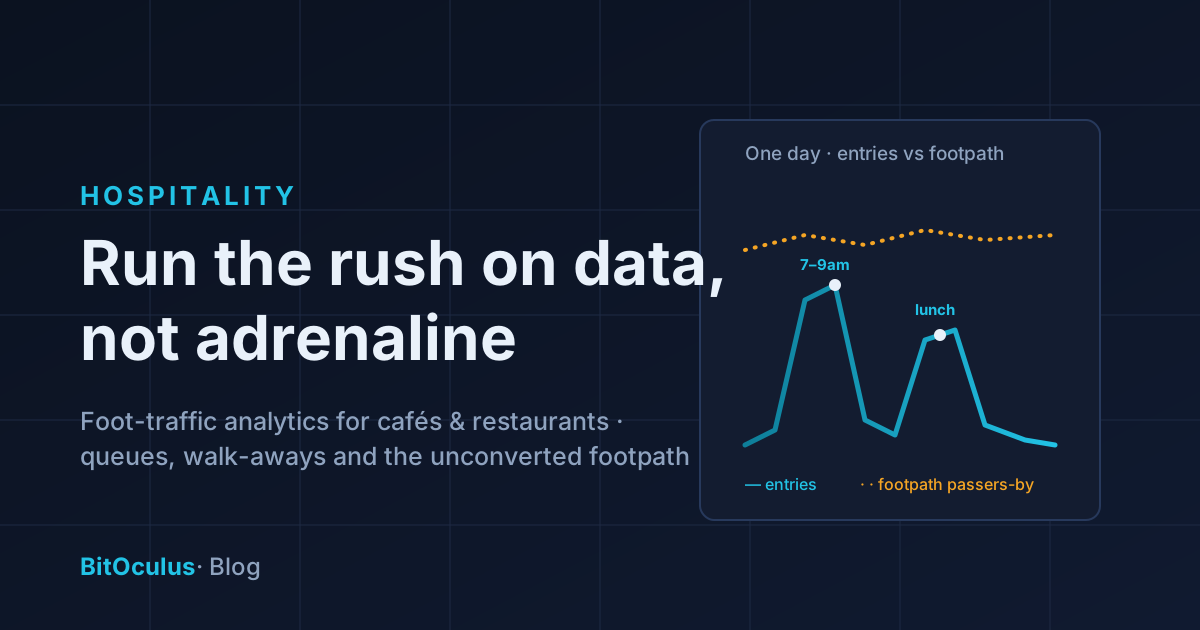
For a café or restaurant, foot-traffic analytics answers the four questions the till can't: how many people walked past and didn't come in, how many walked in and left before ordering, exactly when your rushes start and end, and whether last week's change — a new sign, an extra barista, a menu board — actually moved any of those numbers. Retail gets most of the people-counting attention, but hospitality is arguably the better fit: no other business compresses so much of its revenue into such short, repeatable windows, where being one person short or one queue too long is the difference between a record day and a bad review.
This guide covers what foot-traffic data looks like in a hospitality setting, the three leaks it exposes, and how to use it without pointing a recording camera at your customers or your staff.
A café is a traffic business that measures everything except traffic
Most operators know their numbers cold — average sale, cost of goods, wage percentage — and yet the number underneath all of them is a guess. The till records orders. It says nothing about the person who looked at the queue and walked back out, the couple who tried the door ten minutes after the kitchen closed, or the two hundred commuters who stream past the window every morning without ever coming in.
That blind spot matters more in hospitality than anywhere else because the demand curve is so spiky. A boutique's traffic rolls in gentle waves across the day; a café's arrives as a wall between 7 and 9am, again at lunch, with long valleys in between. When revenue is that concentrated, small timing errors compound: the research on matching labour to traffic found stores systematically understaffed at exactly their busiest hours — and a café's "busiest hour" carries a far bigger share of the day's takings than a store's.
The three leaks a sensor makes visible
1. The rush you're staffing by feel
Every operator thinks they know their rush. The data usually agrees on the middle and disagrees on the edges — and the edges are where the money is. Does the morning rush actually start at 7:00, or 6:40? Does it end at 9:00, or does a second commuter wave land at 9:20 after the express bus? Fifteen minutes of mis-timed coverage at peak, twice a day, six days a week, adds up to a serious annual number — especially under Australian penalty loadings, where the timing of hours matters as much as the count (Fair Work Ombudsman).
An hour-by-hour entry curve, split by day of week, replaces the argument with a chart. Bring the second barista on before the wall hits, not once the queue is six deep — the staffing playbook covers the mechanics.
2. The customers who leave before they order
Hospitality's version of a bounce is brutal and specific: someone walks in, reads the queue, and walks out. The till never sees them; the sensor does. A bounce rate that spikes during your rush is the most actionable alarm in the dataset — it means demand you already won is being handed back at the door, and the fix (one more pair of hands, a faster order point, a pre-order shelf that shortens the visible queue) is usually cheap relative to what it recovers.
Watch it after changes, too. A new menu board that slows decisions, a register moved deeper into the room, a queue that now blocks the doorway — each shows up as a bounce-rate shift within days.
3. The footpath you're not converting
The busiest thing about most cafés is the street outside. An outdoor-capable sensor counts passers-by as well as entries, which unlocks capture rate — the share of the footpath you convert. For a café, capture rate is the honest test of everything the street sees: the A-frame, the awning, the smell of the roast, whether the room looks alive or empty from outside.
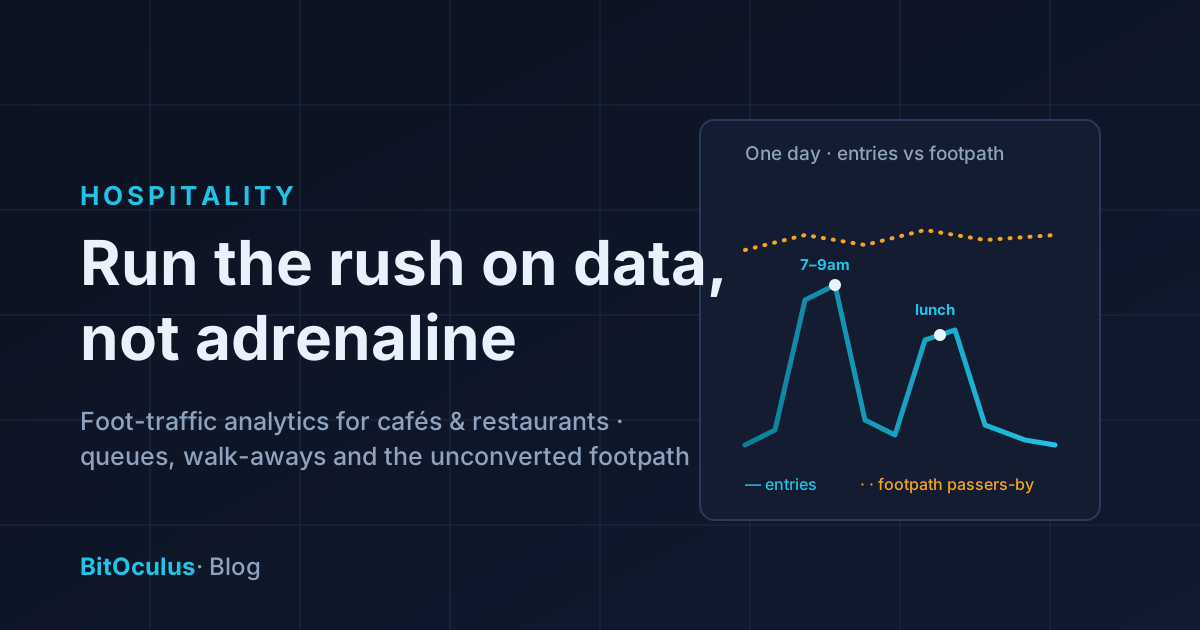
It's also the fairest way to judge a location's ceiling. Two hundred entries a day from a footpath of four thousand is a different business — with different upside — than two hundred entries from a footpath of six hundred. If you're weighing a second site, that's a measurement worth doing before you sign anything.
Make every experiment pay its way
The compounding value isn't any single fix — it's that a measured room turns every decision into a testable one:
- Trading hours. Sunday open worth it? Compare the traffic (and the penalty-loaded wages) instead of debating it. The 3pm close might be leaving a measurable after-school wave on the footpath — or the data might prove the quiet Tuesday arvo really is dead and give you permission to close early with a clear conscience.
- Promotions and partnerships. The loyalty-card push, the local-school fundraiser, the market stall — each either lifted entries against baseline or it didn't. Measure it like a campaign.
- The window and the room. New signage, new lighting, new seating layout: capture rate and bounce rate are the before/after that opinions can't argue with.
Counting people without cameras-in-the-bad-sense
Hospitality has a trust dimension retail doesn't: people linger, eat, meet friends. A recording camera pointed at tables is a bad look, and staff feel surveillance more acutely in a small room. This is where the technology choice matters: an edge-AI sensor processes every frame on the device and discards it in milliseconds — no footage stored or streamed, no faces captured, nobody identified. Only anonymous counts leave the sensor, which is also what keeps it clear of most privacy-law obligations (the legal detail here).
You get the rush curve, the bounce alarm and the capture rate — without a single second of video existing anywhere.
Frequently asked questions
How do cafés measure foot traffic?
With a small people-counting sensor above the entrance. Modern edge-AI sensors count entries, exits and passers-by anonymously — every frame is processed on the device and discarded, so no footage exists. The counts feed an hour-by-hour traffic curve that shows exactly when your rushes start, peak and end, split by day of week.
What is a good capture rate for a café?
It depends heavily on the street and the daypart — a commuter footpath at 8am behaves nothing like a weekend strip at 2pm — so benchmark against yourself rather than a published average. Measure a two-week baseline, then judge signage, window and frontage changes by whether your own capture rate moves during the hours that matter to you.
Can foot-traffic data reduce wage costs in hospitality?
Usually it re-times wages rather than cutting them: hours move out of measured dead zones and into the rush, where they convert queues into orders instead of walk-outs. Under Australian penalty rates the timing question is sharper — weekend and evening hours are premium-priced, so aligning them precisely to measured demand pays back fastest. Peer-reviewed retail research puts the profit impact of fixing peak understaffing at several percent of sales (Mani, Kesavan & Swaminathan, 2015).
How do I know if people are walking out because of the queue?
A sensor that tracks anonymous paths detects bounces — people who enter and leave within a short window without reaching the counter. If bounce rate climbs in lockstep with your rush, the queue (or its appearance) is turning away demand you already attracted; staff the peak or shorten the visible line and watch the number fall.
BitOculus gives cafés and restaurants the rush curve, bounce alarms and footpath capture rate from a single sensor above the door — counted on-device, with no footage ever stored. The founding cohort gets hardware and installation included. Explore a live dashboard or join the founding cohort.