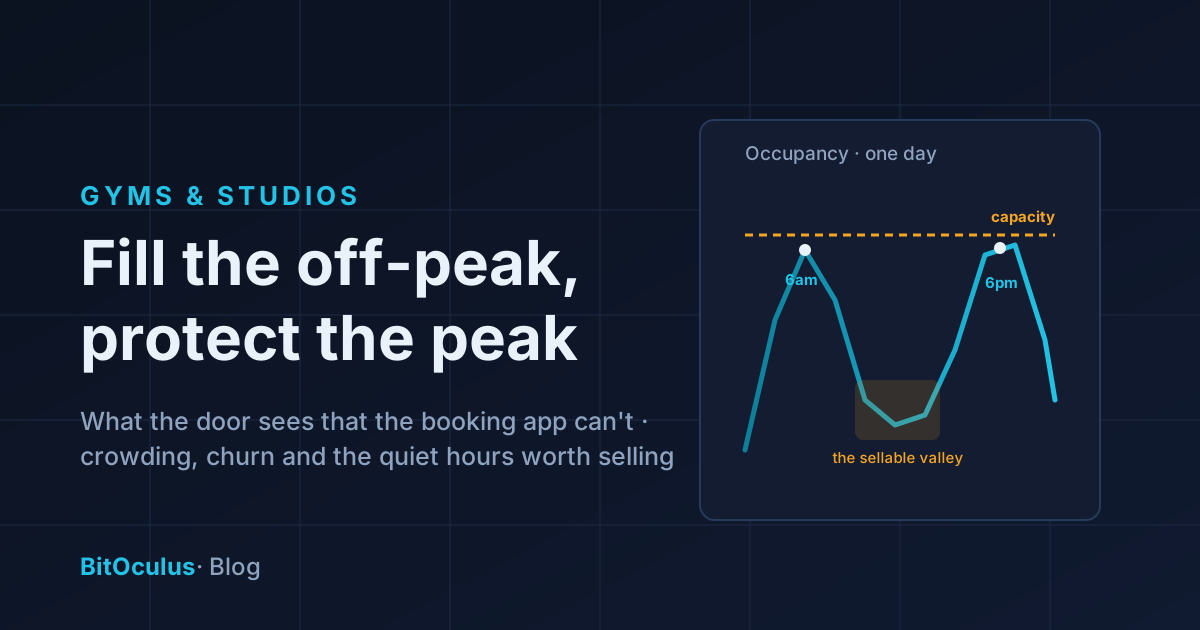
For a gym or fitness studio, foot-traffic analytics measures what the membership system can't: when people actually show up (as opposed to when they booked), how crowded the floor really gets at peak, how many walk-ins approach the door and bounce, and whether the quiet hours you're trying to sell are as quiet as members fear. Check-in software counts the members it knows about at the moment they badge in. The door sees everything — including the crush that makes people quit, and the passer-by who almost became a member.
This guide covers where door data beats booking data, the two problems every gym has (a peak that's too full and an off-peak that's too empty), and how to measure both without pointing a recording camera at people in activewear — a context where privacy isn't a compliance detail, it's the product.
The check-in system sees members. The door sees reality.
Gyms are unusually well-instrumented on paper: badge-ins, class bookings, app check-ins. But that data has systematic blind spots the door doesn't:
- Arrival timing vs booking timing. A 6pm class booked solid tells you nothing about the fifteen people who arrived at 5:40 and queued for the change rooms, or the cardio-floor crowd that overlaps both class windows. Occupancy is driven by presence, not appointments.
- The unmeasured floor. Open-gym usage — the biggest share of many facilities — has no booking record at all. Peak crowding on the weights floor is folklore ("Mondays are chest day, good luck") rather than a measured curve.
- Walk-ins and near-members. The person who walked up, looked through the glass at a heaving floor, and left — the membership system will never know they existed. The door counts them; that's capture rate, and for a street-front studio it's the honest measure of what the frontage is worth.
- Guests, trials and tailgaters. Door counts minus badge-ins is its own metric — how much unbadged traffic the space carries.
None of this replaces the membership system. It's the layer under it: the actual physics of bodies in the room. (How the counting works, anonymously.)
Problem one: the peak that makes members quit
Every gym lives the same double rush — the pre-work window and the post-work wall. The commercial problem isn't the crowding itself; it's that crowding is the churn experience. Waiting for a rack at 6:15pm is the moment a member starts pricing the gym down the road. And because the peak is when the most members are present, the bad experience reaches the most people at once.
A measured occupancy curve turns peak management from vibes into operations:
- Know the real edges. Does the evening wall land at 5:30 or 6:10? Does it break at 7:15 or drag to 8? Staffing, class scheduling and even equipment layout decisions hang on thirty-minute distinctions nobody can eyeball reliably. It's the same edge-finding logic as rostering a shopfront to its curve, with penalty-rate stakes on the staffed hours.
- Schedule classes against the floor, not just the calendar. A popular 6pm class that empties onto an already-full weights floor at 6:45 creates a compound crush the timetable hides. The occupancy curve shows the interference pattern.
- Set a live guardrail. A real-time occupancy alert at your comfort ceiling gives the duty manager minutes of warning — enough to open the second studio space or hold the floor sales tour for later.
Problem two: the valley you're paying rent on
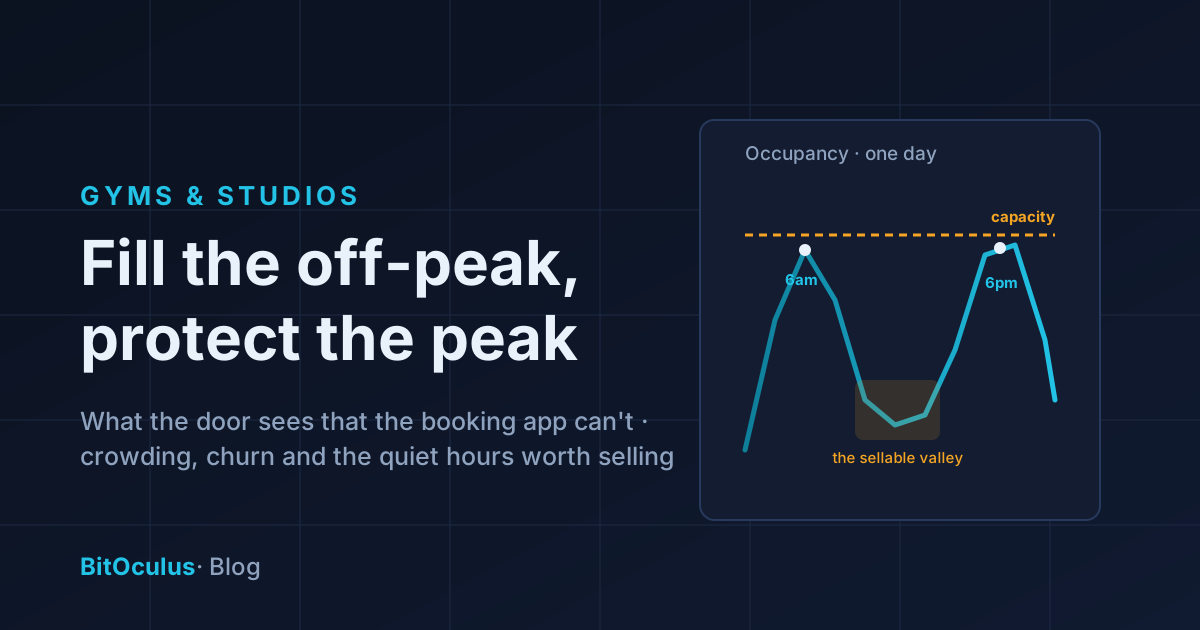
Between the two peaks sits six-plus hours of expensive, mostly-empty floor. The valley is where measured data quietly makes money:
- Sell the quiet honestly. Off-peak memberships, seniors' sessions, PT blocks, and "quiet hours" promises all trade on the claim that 11am is genuinely calm. A measured curve makes the claim provable — show the chart on the wall or in the app and let anxious would-be members see the empty floor they're being offered.
- Price with evidence. If the 10am–3pm window runs at a fraction of evening occupancy, off-peak pricing isn't a discount — it's yield management on floor space you already pay for.
- Judge the experiments. The lunchtime express class, the mums-and-bubs block, the corporate partnership: each either moved the valley's curve against baseline or it didn't. Same discipline as measuring shopfront campaigns — baseline, change one thing, re-measure.
Privacy is the product in a gym
Nowhere is the recording-camera problem sharper than a fitness floor. Members in activewear, change-room-adjacent corridors, kids' classes — a video-based analytics system is a trust incident waiting to happen, and staff feel it too. This is the environment where on-device counting isn't a nice architectural property; it's the difference between a tool you can deploy and one you can't. Edge-AI sensors process every frame on the device and discard it in milliseconds — no footage stored or streamed, nobody identified, only anonymous counts leaving the sensor. The legal and trust detail is here, and it's exactly why a privacy-first counter can go where a camera system shouldn't.
Frequently asked questions
How do gyms measure foot traffic and floor occupancy?
With anonymous people-counting sensors at entrances (and optionally between zones — weights floor, studios, cardio). Entries minus exits gives live occupancy; the hourly pattern by day of week gives the demand curve that class timetables and staffing can be built against. Edge-AI sensors do it without recording anything — frames are processed on-device and discarded.
Can foot-traffic data reduce gym member churn?
Indirectly but meaningfully: overcrowding at peak is one of the most-cited reasons members quit, and you can't manage a crush you only know about anecdotally. Measuring the peak lets you spread load — timetable changes, capacity alerts, honest quiet-hours marketing — and measuring the result tells you whether the fixes worked.
What's the difference between door counts and check-in data?
Check-ins count identified members at the moment they badge in; door counts measure every body entering and leaving, timestamped, including guests, trials, staff and walk-ins who never make it past the front desk. The gap between the two is itself useful — and door data captures presence over time (occupancy), which booking systems structurally can't.
Is it appropriate to use cameras for counting in a gym?
Recording cameras in fitness spaces raise obvious trust and privacy problems. Purpose-built counting sensors avoid them: all processing happens on the device, frames are discarded in milliseconds, no footage exists, and no one is identified. The output is a number, not an image — which is what makes counting workable in privacy-sensitive spaces.
BitOculus gives gyms and studios the real occupancy curve — twin peaks, sellable valleys, live capacity alerts — from anonymous on-device sensors that never store a frame. The founding cohort gets hardware and installation included. Explore a live dashboard or talk to the founder.